A friend of mine leased a spot for a photo puzzle machine right next to a mall escalator. The leasing agent showed him a chart with huge footfall numbers, so he signed. Six weeks in, the machine was doing about one sale a day. We stood there one Saturday watching the crowd, and the reason was plain. People were power walking to the food court or the cinema. Nobody in that hallway was in the mood to turn a photo into a keepsake.
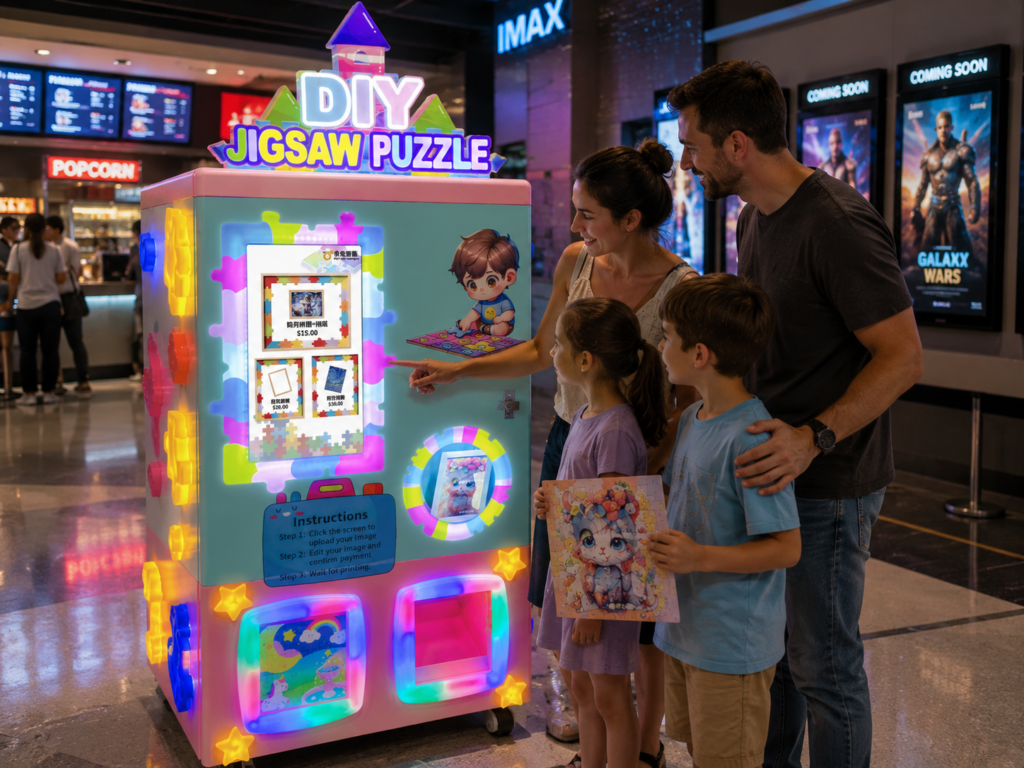
He moved the unit to the third floor cinema lobby two months later. Same machine, same city, completely different story. Parents kill twenty minutes before a show, the kids are bored, and someone uploads a photo just to see what happens. The machine jumped to ten to fourteen orders a day. That move is the whole point of this guide. With a jigsaw puzzle vending machine, the spot is not a detail you figure out later. It is the business.
Why placement decides everything for a puzzle machine
Food vending sells on hunger and impulse. A snack or a cold drink needs no emotional setup. A custom puzzle needs the customer to be in a certain frame of mind. They have to want to capture a moment, a person, or a day out. If the foot traffic around your machine is rushing, distracted, or on a strict errand, the product simply does not land.
This is good news once you accept it. You are not fighting for the busiest corner in town. You are hunting for the right corner, the one where people already feel something. Get that right and a small, cheap footprint beats a prime mall site that costs ten times the rent.
The five venue types, ranked
Here is how the locations Red Rabbit operators run on the CT-PTJ370 compare. The numbers are ranges, not guarantees, and local factors move them a lot. Treat them as a starting hypothesis, then test.
| Venue type | Typical daily orders | Price point | Lease difficulty | Revenue share |
|---|---|---|---|---|
| Tourist attraction | 12 to 18 | $15 to $25 | Moyen | 15 to 25% |
| Shopping mall, family zone | 12 to 15 | $9 to $14 | Moyen | 10 to 15% |
| Cinema lobby | 8 to 14 | $10 to $15 | Low to medium | 10 to 15% |
| Resort hotel lobby | 6 to 12 | $12 to $18 | Moyen | 12 to 20% |
| School or university | 10 to 20 in term | $8 to $12 | Low | 0 to 10% |
Tourist attractions are the anchor location
If I could place only one machine, it would go where visitors already spend money on memories. Aquariums, observation decks, theme park exits, and heritage sites all share a pattern. People have their camera out, they have money engaged, and a generic keychain means nothing next to a puzzle carrying their own photo and the place name.
One operator placed a CT-PTJ370 in a mountain park visitor center gift shop. Average daily sales ran 15 puzzles at about $18 each. Monthly revenue landed near $8,100. Consumable cost was roughly $170. Location rent was $700. Net profit cleared $7,200 a month on a single machine. What made it work was not volume alone. It was that every visitor had just taken photos they cared about. The machine did not have to persuade anyone. It only had to be visible at the moment someone thought, I want to remember this.
Mall family zones and cinema lobbies
Family oriented malls work almost as well as tourist sites, but at a lower price. A machine in a mid tier Chinese mall averages 12 to 15 puzzles daily at $9 to $14. Monthly net runs $3,000 to $5,000. The buyer there is not commemorating a trip. They are bored, the machine looks fun, and the photo is of the kid, the dog, or whatever is on the camera roll. That makes it impulse driven, so price lower and sit near dwell zones.
Cinema lobbies are the sleeper pick. The pre show window is twenty minutes of pure waiting. Put the machine where the line forms and conversions climb. One operator in a provincial city cinema reported 8 to 14 orders a day at $12 average, with no rent because the theater took a 12% cut. The theater liked it because families arrived early and stayed happy in the lobby.
Resort hotels and schools
Family resort lobbies are a quieter winner. Guests are on holiday, relaxed, and already taking photos of everything. A machine there does 6 to 12 orders a day at $12 to $18. The catch is seasonality. A beach resort machine might triple in July and crawl in February. Build that into your cash plan.
Schools and universities are the most overlooked. Students print photos of clubs, graduations, and friend groups constantly. A machine in a student union or dorm commons can do 10 to 20 orders a day at $8 to $12 during term, then drop in holidays. Many schools charge no rent if you frame it as a campus amenity, which means your per puzzle cost falls to about $1.50 and margin climbs past 85 percent.
The foot traffic math
You do not need a million visitors. You need the right few hundred. Photo puzzle machines convert roughly 2 to 4 percent of people who actually stop and read the screen. So to sell 15 puzzles a day, you need about 375 to 750 relevant visitors passing the machine daily. That is a manageable number for a cinema, a gift shop, or a student union.
| Daily visitors past machine | Stop and read (10%) | Convert at 3% | Result |
|---|---|---|---|
| 300 | 30 | 0.9 | ~1 sale a day, too low |
| 600 | 60 | 1.8 | ~2 sales a day, marginal |
| 1,200 | 120 | 3.6 | ~4 sales a day, workable |
| 2,500 | 250 | 7.5 | ~8 sales a day, strong |
| 5,000 | 500 | 15 | ~15 sales a day, anchor site |
The lesson is simple. Do not be fooled by a headline footfall number. Ask how many of those people are standing still long enough to notice a machine. A corridor with 20,000 hurrying commuters will lose to a cinema lobby with 800 relaxed families.
Negotiating a revenue share
Most good puzzle locations do not want a fixed rent. They want a cut of sales, because a dead machine in their space hurts their brand. A revenue share of 10 to 20 percent is normal, and it protects you on slow days. When you negotiate, lead with what the machine does for them. It is a free amenity that keeps families lingering, it photographs well for their social media, and it carries no staffing cost.
One operator in a Shanghai immersive exhibition paid zero rent and gave the venue 15 percent. The venue won a branded souvenir, the operator won zero rent on off days, and the machine converted about 3 percent of the 800 to 1,200 daily visitors. During the show run, monthly net hit $7,800 to $11,500. The share deal was the reason the math worked at all.
Red flags that kill a puzzle machine
Some spots look great on paper and fail in person. Watch for these:
No place to stand. If there is no bench, seat, or waiting area within a few meters, people walk past. The machine needs a dwell pocket around it.
Task focused foot traffic. Transit corridors, supermarket exits, and office building lobbies are full of people who are late for something. They will not stop for a keepsake.
No visible demo. If the screen just shows a logo, passersby do not understand they can use their own photo. A five second looping demo of the print process lifts conversions by a fifth.
Competing for the same eye. Do not place it next to a loud cotton candy or slush machine. You want the calm, photo friendly corner, not the sugar rush corner.
Seasonal planning
Map your year before you sign. Tourist sites peak in holidays. Resorts swing with the season. Schools die in summer. The operators who last build a portfolio that balances these curves, or they line up a second location they can shift the machine to in the off season. A CT-PTJ370 breaks down into a 194 by 116 by 110 cm package, so moving it between sites is a half day job, not a logistics project.
Frequently asked questions
How much space does the machine need?
The CT-PTJ370 footprint is about 226 by 106 cm, with a height near 100 cm. You need a flat spot with a power outlet and a stable wireless or mobile signal for the QR photo upload.
Do I need permission from the venue?
Yes. Most placements are a written agreement with a revenue share or a fixed monthly fee. The National Automatic Merchandising Association publishes placement guidance that is worth reading before you negotiate. See vending.org.
What if the spot underperforms?
Move it. Because the consumables are just paper and ink, a pivot costs you one trip and a half day of labor. That flexibility is why operators test two or three sites in the first quarter.
Is a puzzle machine a good first vending venture?
For patient operators who pick the right dwell zone, yes. The Red Rabbit PTJ series runs unattended, needs no food safety permits, and the SBA small business guide is a useful starting point for the paperwork in your market.
Ready to scout your first spot? Explore the Red Rabbit jigsaw puzzle vending machine specs, then nous contacter to talk through placement, power, and shipping for your market.