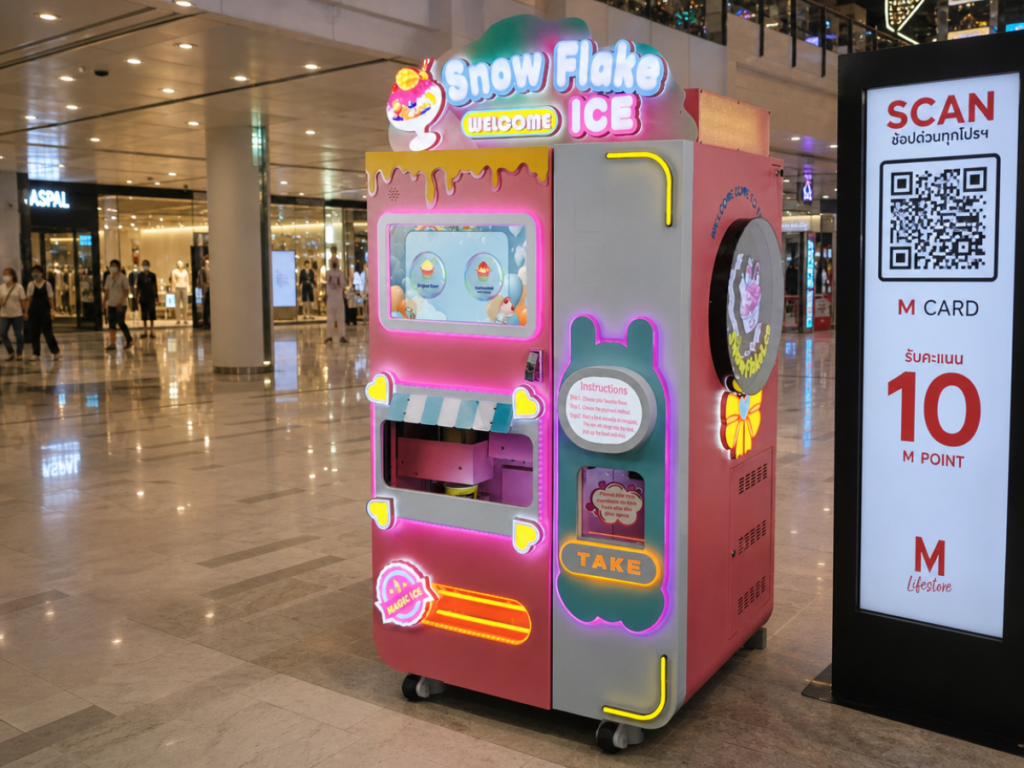
I spent a 38°C afternoon in Bangkok last month standing in a line that didn’t move. Not at a restaurant. Not at a bubble tea shop. In front of a vending machine. A Red Rabbit snowflake ice machine, to be specific — one of those automated units that takes a block of frozen dessert base, shaves it into ribbons so fine they look like fresh snow, and tops it with syrup and toppings in under 60 seconds. The line was 12 people deep at 3 PM on a Tuesday. Nobody seemed bothered by the wait. They were watching the machine through the glass.
That machine did 87 servings that day at 120 baht each ($3.40). Daily revenue: roughly 10,440 baht ($295). Monthly? Nearly $8,900. From a machine the size of a refrigerator, sitting in the corner of a Bangkok shopping mall.
Сайт snowflake ice vending machine sits at an intersection of three trends that are converging hard in 2026: automated food service, Asian dessert globalization, and the death of the manned kiosk. But here’s what separates the operators making $8,000/month from the ones making $1,500: they don’t think of it as a vending machine. They think of it as a dessert shop that happens to run itself.
What Is Snowflake Ice — And Why Does It Matter?
Snowflake ice — known as bingsu in Korea, kakigori in Japan, baobing in China, and halo-halo’s frozen cousin in the Philippines — is shaved frozen dessert base with the texture of fresh powder snow. Not crushed ice. Not a slushie. The ice ribbons are so thin they melt on contact with your tongue. It’s a fundamentally different experience from the chunky, crunchy ice most Western consumers associate with “shaved ice.”
An automated machine like the CT-BS310 takes this process and removes the human entirely. Store the frozen base blocks in the machine’s freezer compartment. The machine shaves, portions, adds syrup and up to three toppings, and delivers. A human makes maybe 30 servings per hour and gets fatigued. The machine makes 50–60 and never needs a break.
The dessert itself costs about $0.40–$0.55 in raw materials per serving (frozen base, syrup, topping). It sells for $3–$6 depending on the market and venue. That’s a product with a roughly 88% gross margin that also happens to be trendy, photogenic, and unlike anything most competitors are selling.
Why This Machine Works Now (And Why It Wouldn’t Have Five Years Ago)
Three things changed:
First, global dessert culture shifted. Korean bingsu chains like Sulbing have expanded internationally. Halo-halo has become a social media staple. Asian shaved ice desserts are no longer exotic — they’re aspirational. A snowflake ice machine in a Western mall in 2026 isn’t a weird curiosity. It’s on-trend.
Second, labor costs made manned dessert kiosks inefficient. A dessert shop employee costs $15–$25/hour in developed markets. They work 8-hour shifts. They call in sick. They quit. A machine costs the electricity it uses plus 3 hours of weekly attention from an operator. In markets where minimum wage is rising faster than machine costs, the economic crossover keeps tilting toward automation.
Third, the machines got reliable enough. Early automated food machines had a reputation for breaking down. The current generation — units like the CT-BS310 — are built for unattended operation with sealed refrigeration, self-cleaning cycles, and remote monitoring. Downtime on a well-maintained unit averages 1–2 days per year, not per month.
The Revenue Math — City by City
Snowflake ice pricing varies enormously by market because the product’s perceived value depends on whether consumers already know what it is.
Bangkok, Thailand — High Heat, High Volume, Known Product
Thai consumers know shaved ice desserts. The machine doesn’t need to educate anyone. It just needs to be cold and visible.
| Метрика | Value |
|---|---|
| Daily sales | 60–90 servings |
| Average price | 120–150 baht ($3.40–$4.25) |
| Monthly revenue | 216,000–405,000 baht ($6,100–$11,500) |
| Base + syrup + topping cost | ~15 baht/serving ($0.42) |
| Mall rent | 20,000–35,000 baht ($565–$990) |
| Ежемесячная чистая прибыль | $4,200–$8,900 |
The Bangkok machine I watched runs in a mid-tier mall near a university. Students and young professionals are the core demographic. Peak hours: 12–2 PM and 3–5 PM — lunch and post-class sugar cravings. The machine does almost nothing before 11 AM, which tells you something about who’s buying and when.
Los Angeles, USA — High Price, Education Required
In a market where bingsu is still a niche product rather than a staple, pricing goes up but volume is harder to build.
| Метрика | Value |
|---|---|
| Daily sales | 25–45 servings |
| Average price | $5–$7 |
| Monthly revenue | $3,750–$9,450 |
| Per-serving cost | ~$0.55 |
| Rent + utilities | $800–$1,500 |
| Ежемесячная чистая прибыль | $2,200–$7,300 |
The LA operator I spoke with placed their machine in a Koreatown mall. The built-in audience understood the product immediately. A machine in a generic American mall without a pre-educated customer base would need signage, sampling, and probably 3–6 months to build regular traffic. The payback math still works — a $5,000 machine at $2,200/month net recoups in under 3 months — but the ramp-up is slower than in markets where consumers already know what snowflake ice is.
Dubai, UAE — Premium Market, Indoor Dominance
Dubai’s 45°C summer temperatures make any frozen dessert an easy sell, but snowflake ice has an additional advantage: it’s photogenic, and Dubai consumers are image-conscious.
| Метрика | Value |
|---|---|
| Daily sales | 40–60 servings |
| Average price | 25–35 AED ($6.80–$9.50) |
| Monthly revenue | 30,000–63,000 AED ($8,200–$17,200) |
| Per-serving cost | ~2 AED ($0.55) |
| Mall rent | 5,000–10,000 AED ($1,360–$2,720) |
| Ежемесячная чистая прибыль | $5,800–$13,700 |
Dubai is unusual because the entire retail environment is indoors and air-conditioned, but outdoor temperatures create year-round demand for cold desserts. A machine in Dubai Mall or Mall of the Emirates can run 365 days without seasonal dips. The trade-off: mall rents are high in premium locations, and competition for good spots is intense.
Seasonality — The Real Profit Timeline
Any frozen dessert business faces seasonality. Snowflake ice is no exception. But the machine’s ability to run unattended changes how you handle it.
Northern Hemisphere Seasonal Pattern
| Season | Months | Expected Volume | Strategy |
|---|---|---|---|
| Peak | Jun–Aug | 100% (baseline) | Full operation. Stock heavily. Price at market ceiling. |
| Shoulder | Apr–May, Sep–Oct | 60–70% | Reduce toppings variety to cut waste. Run promotions. |
| Off-peak | Nov–Mar | 30–50% | Consider hot alternatives or temporary relocation. |
The key insight: your cost structure doesn’t change much between peak and off-peak. Rent is the same. Electricity varies slightly. Consumables scale with volume. So even at 40% volume during winter months, you’re likely still profitable — just less so. A machine earning $7,000/month in July might earn $2,500 in January. That’s not a loss. That’s a seasonal dip.
The Hot Drink Pivot
Some snowflake ice operators in seasonal markets add a second machine that produces hot drinks during winter months — a cotton candy machine or a coffee vending unit placed in the same mall. Same location footprint, same operator visits, revenue stream that hedges against seasonality. The marginal cost of managing a second machine at the same location is minimal once you’re already visiting weekly for the first one.
Pricing Psychology — What Customers Actually Pay
The difference between a $3.50 cup and a $6 cup of snowflake ice isn’t the cost of ingredients. It’s the perceived category the machine sits in.
- $3.50 = “vending machine dessert” — competing with ice cream bars and soda
- $5.00 = “cafe dessert” — competing with Starbucks Frappuccinos
- $6.50+ = “specialty dessert shop” — competing with dedicated bingsu cafes
The machine produces the same product at all three price points. The question is where the customer’s mental reference point sits. In Bangkok, where street food desserts cost $1–$2, $4 is a premium price. In a Los Angeles mall where a Cinnabon costs $6, a $6 snowflake ice is priced competitively.
One operator I know uses a simple test: set the price at what feels slightly too high, run for two weeks, then drop by $0.50 if volume doesn’t meet targets. Most operators find their final price is higher than their initial guess. Customers don’t price-compare a machine that makes fresh snowflake ice to order. There’s no reference product.
Operating the Machine Day-to-Day
Stocking & Refilling
A fully stocked CT-BS310 holds enough frozen base blocks, syrup, and toppings for roughly 250–300 servings. For a machine doing 40 servings daily, that’s one restock per week. The operator visits once weekly, swaps in frozen base blocks from a freezer (keep a small chest freezer near the machine or bring blocks each visit), refills syrup and topping containers, and cleans.
Total weekly time: 45–60 minutes for one machine. Add 15–20 minutes for each additional machine if they’re in the same mall.
Очистка
Food safety is the one area where snowflake ice machines demand more attention than, say, a cotton candy machine. The machine handles dairy or dairy-alternative frozen base in a refrigerated environment. A weekly deep clean of the shaving mechanism and syrup lines takes about 20 minutes. Skip it for two weeks and you risk off-flavors, clogged syrup nozzles, and — worst case — a health inspector with questions.
Good operators treat the cleaning schedule as non-negotiable. The 20 minutes you save by skipping a week costs you a day of downtime if a syrup line clogs and requires a service call.
Удаленный мониторинг
Modern machines send real-time data — sales volume by hour, inventory levels, temperature readings, error codes. The operator checks the dashboard once or twice daily from their phone. An alert for low inventory or a temperature anomaly triggers a same-day visit. Everything else can wait until the weekly restock.
Who Should Buy a Snowflake Ice Machine
This isn’t for everyone. Here’s who it works for, and who should look elsewhere.
Good fit: – You have access to a mall or entertainment venue with 5,000+ daily visitors – You’re in a warm climate (tropical, subtropical, or desert) with a long or year-round season – Your target market has some exposure to Asian desserts, or you’re willing to invest in sampling and education to build it – You want a machine that runs autonomously with weekly attention – You’re comfortable with food safety requirements and regular cleaning protocols
Bad fit: – You’re in a cold climate where frozen desserts are a 3-month product – Your target location has under 2,000 daily visitors – Your market has zero exposure to Asian shaved ice and you’re not willing to educate – You want a machine you can ignore for weeks at a time – You’re uncomfortable handling food products with dairy components
Часто задаваемые вопросы
How is snowflake ice different from a slushie or shaved ice machine? Slushies are frozen drinks — crushed ice mixed with syrup in liquid form. Traditional shaved ice is chunky and crunchy. Snowflake ice uses a frozen base block that shaves into micro-thin ribbons, creating a texture closer to fresh snow that melts instantly on the tongue. The mouthfeel is completely different.
What flavors and toppings can the machine offer? Standard: mango, strawberry, matcha, chocolate, milk tea. Toppings: mochi, red bean, condensed milk drizzle, fruit pieces, cookie crumbles. The number of variants depends on how many syrup and topping containers the machine holds.
How much training is needed to operate? About 2–3 hours to learn: stocking frozen base, refilling syrup and toppings, weekly cleaning procedure, and navigating the remote monitoring dashboard. No culinary training needed. The machine handles all preparation.
What certifications or permits are needed? Varies by jurisdiction. Most locations require a basic food handling permit. The machine’s sealed refrigeration and self-cleaning system simplify health department compliance compared to open-air food preparation. Check with your local health authority.
Can the machine offer hot desserts in winter? The snowflake ice machine is designed for frozen desserts only. Operators in seasonal markets often pair it with a hot-drink vending machine at the same location to hedge winter dips.
What’s the biggest risk? Underestimating the location’s seasonal volume drop. A machine that earns $8,000 in July and $2,500 in January is still profitable, but if you budgeted based on July numbers alone, you’ll be disappointed for five months. Always model annual revenue, not peak-month revenue.
Want to explore snowflake ice vending? Browse the CT-BS310 product page for full specifications, or связаться с Красным Кроликом to discuss placement viability and pricing for your target market.