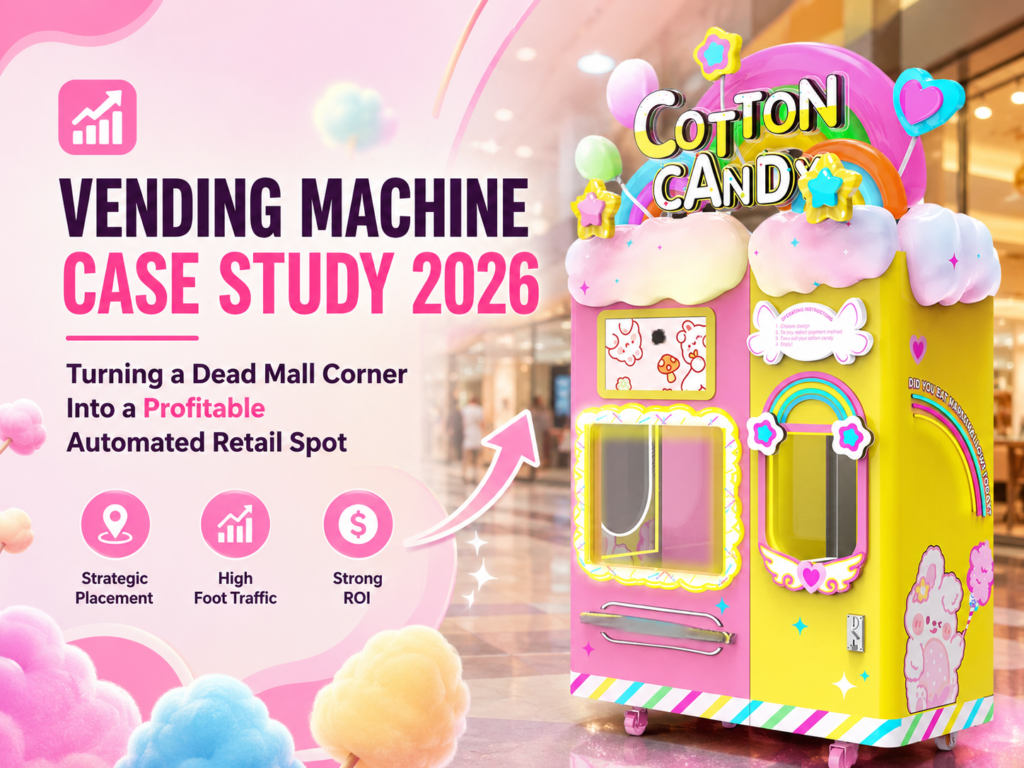
In March of this year I sat down with an operator I will call Daniel. He runs a small vending route in a mid-size city in the American Midwest, and he had a problem that was easy to describe and hard to fix. He had leased a corner unit inside a suburban mall that had been losing tenants for years. The anchor store closed two years ago. Foot traffic thinned to a trickle on weekdays. Management offered him a short, cheap lease just to keep the corner from looking abandoned. Daniel put a standard snack and soda machine there and waited for it to earn its keep. It did not.
His best month on that corner was $220 in gross sales. He was paying more in commission and restocking labor than the machine brought in. Most operators I know would have walked away and called it a bad location. Daniel decided to treat it as a data problem instead. What he did over the next ninety days is a useful case study for anyone trying to figure out where automated retail is actually heading in 2026.
The Diagnosis: A Dead Corner Was Never the Real Problem
Daniel pulled three months of transaction logs and looked at what the machine was really telling him. The corner was not empty all day. It had two short windows of movement, the school pickup hour around 3 p.m. and a weekend family window between noon and 4 p.m. The people walking past were mostly parents with kids, teenagers, and families waiting for something else to happen in the mall.
A snack and soda machine gave those people nothing to stop for. A bag of chips and a bottle of water is a purchase you make when you are already hungry, not something that makes you cross a hall. The corner was not dead because nobody passed it. It was dead because the machine offered a generic transaction to an audience that wanted something to watch, share, and remember.
That distinction matters more than it used to. The vending business is splitting into two camps. One camp sells commodities, chips and drinks and candy, and competes almost entirely on price and location. The other camp sells an experience, a product made in front of you, and competes on attention. Daniel’s corner belonged to the second camp, and he had stocked it like it was the first.
What the 2026 Market Data Was Telling Him
The industry numbers from this year point in the same direction. Research on the smart vending market puts it at roughly $11.6 billion in 2026, growing about nine percent a year through the early 2030s. Cashless payments now drive the large majority of vending revenue in the United States, which removed the biggest old friction point, the need for exact change. More telling for Daniel, specialty and made-to-order machines are the fastest growing product type, expanding faster than the familiar snack and beverage categories that have already saturated.
The market is also strikingly fragmented. In the U.S., the top four operators control only around six percent of the whole market, which means independent operators are not fighting giants, they are competing against other small players on execution. That fragmentation is the opening. The National Automatic Merchandising Association has tracked this shift for years, and the small operator who reads a location correctly can still beat a national account on that one corner.
None of this told Daniel what to stock. It told him the floor under his feet had moved. The machines winning in 2026 are the ones that turn a passing crowd into a small group gathering around a window.
The Pivot: From a Vending Box to an Experience
Daniel pulled the snack machine and replaced it with a machine that makes cotton candy in front of the customer. The choice was deliberate. Cotton candy is cheap to produce, a few cents of sugar per serving, and it creates a moment. The machine spins, the sugar fluffs into a cloud, and people stop to watch. A parent buys one for a child and suddenly two more kids want one. A teenager films it for a short video.
He did not stop at one machine. He put the cotton candy unit in the corner and paired it with a small photo keepsake option, the kind of laser engraving machine that puts a family photo onto a glass or acrylic keepsake on the spot. Now the corner had a reason to exist. It was a small destination, not a rest stop.
He also cut over to card and mobile payment entirely and stopped stocking cash float. That single change removed the most common reason a machine sat idle, a customer who walked up with a card and no coins.
For anyone evaluating machines like this, the Small Business Administration’s business guide is a good free starting point for the basic math of a route, lease terms, and what to ask before you sign with a location.
The Numbers After 90 Days
Here is the before and after, the way Daniel showed it to me.
| Metric | Snack Machine (Before) | Cotton Candy + Keepsake (After) |
|---|---|---|
| Monthly gross | $220 | $3,100 |
| Average transaction | $2.40 | $8.60 |
| Peak window | Weekend only | Weekend + weekday pickup |
| Restock visits per week | 1 | 2 |
The gross number tripled within one season, but the more important change was the transaction value. A cotton candy that costs a few cents to make sells for several dollars, and the keepsake option pushed the average ticket past eight dollars on weekends. The corner was still not a top location on his route, but it went from a loser to a steady middle performer, and the weekend window alone covered his lease and commission.
His cost structure changed too. He was restocking more often because the machine sold through faster, not because it broke. The maintenance questions shifted from jammed coils to cleaning the spinning head and the sugar, which are fast, predictable jobs.
What Daniel Would Do Differently
He had three regrets, and all three were about timing. He should have tested the school pickup window sooner instead of assuming the corner was dead all day. He should have negotiated the commission on the experience machines before install, because the location saw the higher ticket and wanted a bigger cut. And he should have set up the photo keepsake from day one rather than adding it in month two, since the keepsake was what turned a one child purchase into a family purchase.
His biggest lesson was the simplest. The machine did not fail because the location was bad. It failed because the product did not match the audience. The same corner, the same lease, the same traffic, produced a completely different result once the offer changed.
What This Case Means for Other Operators
If you are choosing your next machine or your next location, the takeaway is not that every operator should buy a cotton candy unit. It is that you should match the offer to the crowd before you blame the corner. A high traffic transit stop still sells bottled drinks all day. A family mall, a fair, a tourist strip, or a boardwalk wants something made in front of the customer.
This is why the experiential side of the market is growing faster than the commodity side. A machine that makes something in ten seconds gives people a reason to stop, and a reason to come back. A machine that just holds chips only wins when nobody else is nearby. In 2026, the second kind of location is getting harder to find, and the first kind is where the independent operator has room to win.
If you want to look closer at the machines Daniel used, the Distributeur automatique de barbe à papa and the laser keepsake engraving machine pages show how each one works and what they cost to run. When you are ready to talk through a specific location, the team can help you think through the offer before you sign anything, through the contact page.