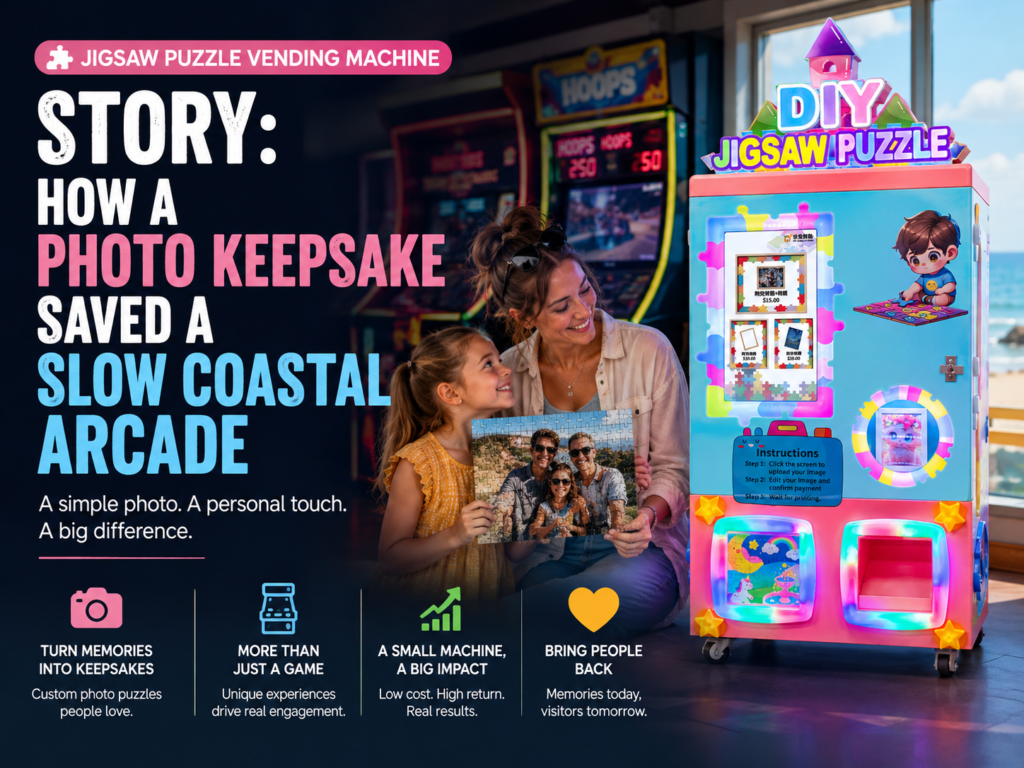
Dani owns a small family fun center about an hour from a beach town in Portugal. The summer months print money. The winter months, as she puts it, print nothing but dust on the skee-ball machines. I met her last spring because she had done something worth writing down. She took the deadest corner of her arcade, the spot where a broken claw machine sat for eleven months, and turned it into the busiest square meter in the building. The machine that did it was a photo jigsaw vending machine.
An Empty Corner and a Question Nobody Planned For
Dani did not set out to buy a puzzle machine. She set out to fix a winter. Her revenue dropped by more than half every November and stayed down until Easter. Families still came in, she told me, but they came for the trampolines and the birthday parties, not for the grab machines that stopped feeling exciting years ago.
The idea started with a customer. A grandmother walked up to the counter holding a phone and asked whether the print shop next door could turn a photo of her three grandkids into a puzzle for a birthday. The print shop could not, at least not while she waited. Dani watched the woman leave disappointed and thought about how often the answer to a simple question was a no.
That small moment pushed her toward a photo jigsaw vending machine. The model she settled on was a Red Rabbit unit, the CT-PTJ370. What drew her in was not the price tag. It was that the machine takes a customer’s own photo and turns it into a real puzzle while they stand there, a couple of minutes, watching their picture become something they can hold.
Why a Puzzle Instead of Another Vending Machine
Dani already had drink machines and a candy machine near the entrance. They did fine, but they were interchangeable. A soda machine is a soda machine whether it sits in her arcade or in a hospital lobby. What she wanted was something that belonged to her location, something a tourist could not get anywhere else on the strip.
A photo puzzle does that. It is not a product you grab and forget. It is a souvenir with your own face on it, or your kid’s face, or a picture of the sunset you took twenty minutes earlier. Dani framed the whole pitch around one word: keepsake. The machine does not compete with the trinket shops selling the same printed magnets as every other town. It makes something personal, on demand, right in front of the customer.
There is a technical detail worth getting right here, because it shapes what the machine actually sells. A photo jigsaw vending machine like the CT-PTJ370 prints the image directly onto a puzzle board. It does not print flat photos or postcards, and it does not turn photos into some other product. It makes a puzzle. That single-mindedness is the point. The customer comes for a puzzle, watches a puzzle being made, and walks out with a puzzle.
The First Week and the Turn
The first week was slow, and Dani almost panicked. The machine sat in its corner, clean and quiet. Tourists walked past it. The problem was not the machine. It was that nobody knew what it did. A puzzle machine looks like a photo booth, and people in a hurry do not stop to read a sign.
So she changed the setup. She mounted a finished sample puzzle on a stand beside the machine, a bright photo of a family at the beach, already assembled. She added a short sign in two languages: “Your photo, a puzzle, three minutes.” Then she trained the counter staff to mention it once, in passing, when someone paid for a birthday party or asked where the bathroom was.
That was the turn. Once people saw a finished puzzle and heard it took only a few minutes, they tried it. A family of five would crowd around the screen, pick a photo, and watch it print. Kids loved pressing the button. Parents loved that it was not another screen game. By the end of the second week the machine was running all afternoon on weekends.
How the Numbers Shaped Themselves
Dani keeps the unit economics simple, and she was open about them. A standard puzzle board costs her a little over a dollar in material, and a framed version a bit under two dollars. At her location, where tourists expect to spend on souvenirs, she prices a standard puzzle at $15 and a framed one at $25. She does not price by what photo the customer picks, and she does not slice the product into a dozen options. One puzzle, two formats, priced for the place it sits. That keeps the menu small enough for a kid to understand.
The machine itself was around the low five-thousand range, which she recovered faster than she expected because the peak season carried most of it. I will not turn this into a spreadsheet, because the point of her story was never the math. It was that a machine people understand in three minutes beats a machine that needs a manual.
What Winter Looks Like Now
The part that surprised Dani most was what happened after summer. She had bought the machine to fix winter, and winter is where it earned its keep in a different way. Tourists stop coming in November, but locals do not. Grandparents came in to make puzzles of new babies. Parents made puzzles of school photos. A teacher booked the corner for an afternoon and let twenty kids each print a puzzle of their class picture.
The machine changed the shape of her year. Summer became about volume, one tourist after another. Winter became about gifts, smaller numbers but steady and personal. The corner that once held a broken claw machine now has a small queue on a rainy Saturday in February.
What I Took Away From Her Setup
Dani’s story is not a promise that a puzzle machine prints money anywhere. It is a reminder that location and the reason you give people matter more than the hardware. She did not win because she bought a clever machine. She won because she put it where people already stood, showed them a finished product, and told them in one sentence what it did.
If you run a family entertainment center, a tourist stop, a museum gift area, or an arcade, the same logic applies. A photo jigsaw vending machine earns attention by being something people have not seen, and it keeps them by giving them something personal to take home. You can read more about the specific unit and its details on the jigsaw puzzle vending machine page, and if you want to talk through whether it fits your space, the contact page is the fastest way to start a conversation.
Before you commit to any vending equipment, it is worth reviewing the fundamentals that apply to every small operation. The U.S. Small Business Administration keeps a solid, plain-English business guide that covers planning and location the way a banker would want to see it. And the National Automatic Merchandising Association publishes industry data and best practices for operators at vending.org, which helps when you are comparing machine types across a full arcade.
Dani’s corner used to be a place nobody looked. Now it is the reason people take a photo before they even step inside. That is the difference a keepsake machine makes, and it is the difference that stuck with me after I left her arcade.