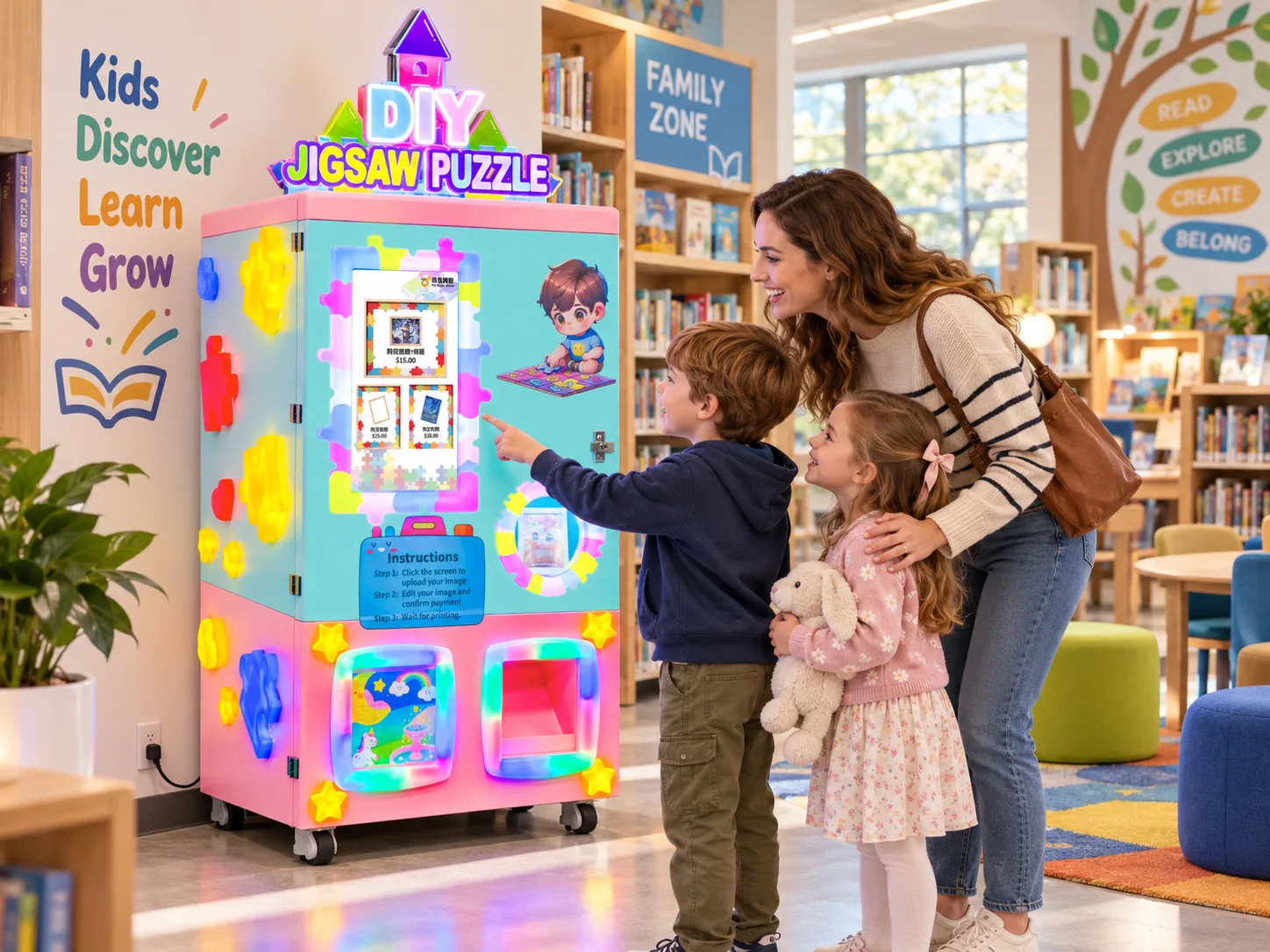
Most operators I talk to have never seen a jigsaw puzzle vending machine before they call us. They know photo booths and cotton candy machines. A machine that takes a customer’s own photo and turns it into a real puzzle board on the spot is new to almost everyone, so the same questions keep coming up. This page collects the ones that matter and answers them the way I would on a call.
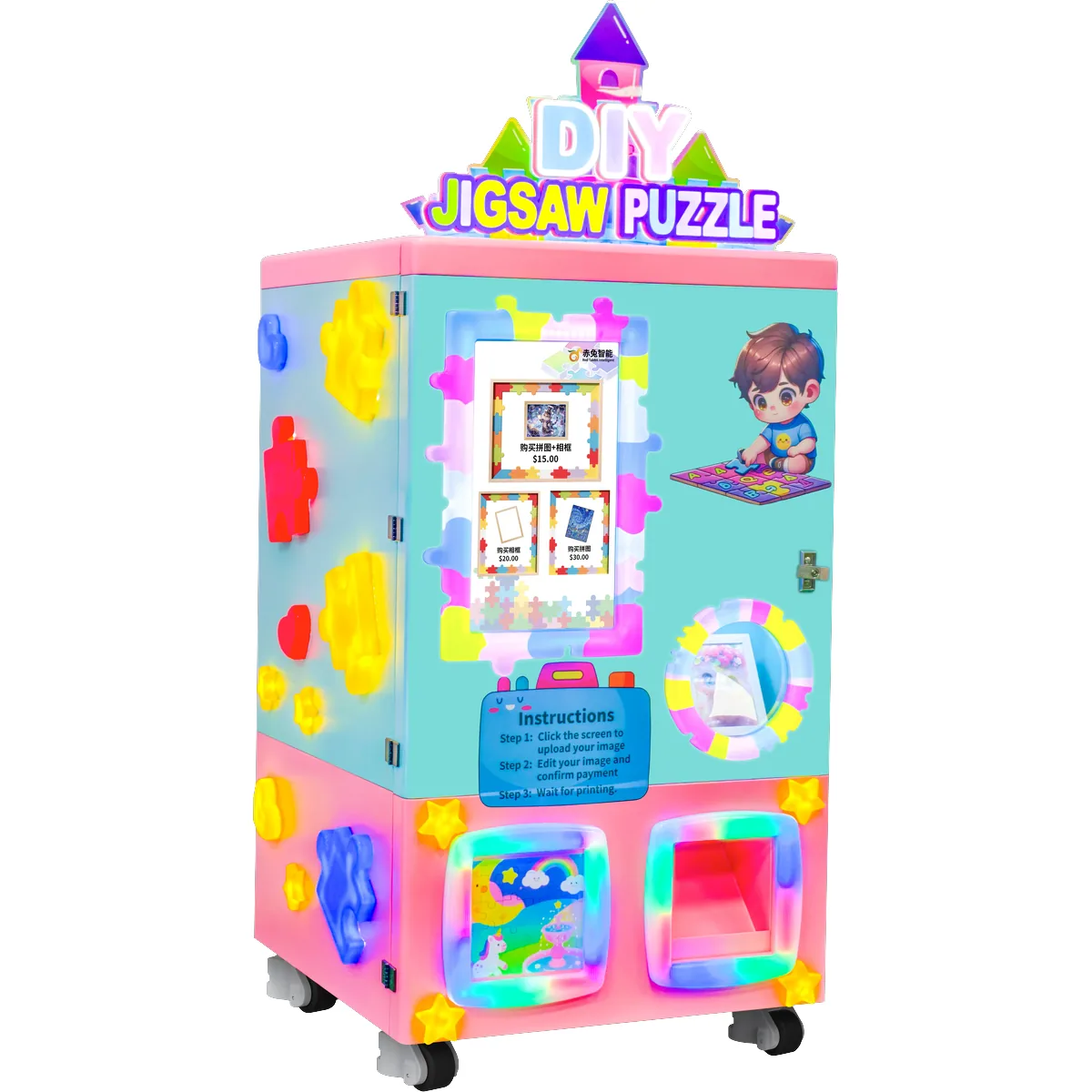
What exactly does this machine make?
One thing, done properly. It prints a customer’s photo directly onto a blank jigsaw puzzle board, then cuts that board into pieces the customer takes home in a box. It is not a photo printer with a puzzle mode tacked on. The machine is built around the puzzle board itself. There is no flat print setting and no postcard setting. The board goes in, the photo goes on, the cutter finishes the job, and the customer leaves with a puzzle.
That narrow focus is on purpose. A machine that tries to do ten things does all of them in a mediocre way. This one makes a single keepsake and makes it reliably, which is what you want when it has to run unattended for hours at a time.
How long does one puzzle take?
Two to three minutes from photo to finished box for a standard board, a little longer for a framed one. That covers the photo selection, the printing, the cutting, and the packaging. It is quick enough that a family of four can each make one without anyone getting restless, and slow enough that the result feels crafted rather than dispensed. The printing itself is fast. Most of the time goes to the cutter making clean edges and to the customer deciding which photo to use.
Do I need to stock a wall of different blank puzzles?
No. This is the thing operators get wrong before they see the machine up close. There is a single puzzle product in two formats, a standard board and a framed board. You do not buy different stock for different photo types. A landscape photo, a baby photo, and a wedding photo all print on the same blank. The photo content does not change your material cost. You keep two kinds of consumables on hand and nothing more, which keeps inventory simple and cheap to restock.
How should I price it?
By location, not by photo. A puzzle in a busy resort gift shop can carry a different price than the same puzzle in a small town arcade, and both prices can be right. The cost of the blank is identical either way, so the gap comes down to what your foot traffic will actually pay. Operators who price the same everywhere leave money on the table in high demand spots and scare off buyers in quiet ones. Pick a price that fits the venue, then adjust it after you watch the first few weeks of sales.
A photo puzzle is not a print, it is a keepsake. Operators who treat it that way price it by the venue and watch it sell itself.
What kind of photo can a customer use?
Any photo on their phone. A selfie, a group shot from a birthday, a picture of a pet, a landscape from a holiday. The machine connects to a phone to pull the image, or the customer uploads one. The point is that the keepsake is personal. A store bought puzzle is generic and gets tossed in a drawer. A puzzle with your own photo on it is something people keep and show off, and that is exactly why the machine earns its place in a gift shop or an arcade.
Where does it perform best?
Wherever people are already in a keepsake mood. Tourist attractions, seaside arcades, family entertainment centers, gift shops, museum exits, and resort lobbies all work. The machine sells the idea of a memory turned into an object, so it does best where memories are being made. It is weaker in commuter heavy spots where nobody is thinking about souvenirs. One operator told me the puzzle machine next to his beachside ice cream counter outsold the one in a city rail station three to one, and neither of us was surprised.
Does it need staff to run it?
No, that is the whole point. A customer walks up, picks a photo, pays, and the machine does the rest. You do not need an attendant to explain the product or handle cash. You do need to keep the blanks stocked and empty the small waste bin, which is a few minutes per visit rather than a full shift. The machine is built for unattended use, with a self guided screen that walks each customer through the steps.
Is it hard to maintain?
Daily upkeep is small. Keep the print area clean, check the blank inventory, and clear away any paper dust. The cutter is the part that needs the most attention, and even that is usually a wipe down and a visual check. There is no food, no refrigeration, and no liquid, which removes most of what makes vending machines break down. A quick weekly pass plus a proper service when the machine prompts you is enough to keep it running for years.
What about permits and payments?
Most places treat it like any other retail vending unit. You may need a standard business registration and a placement agreement with the venue owner, and you should check your local rules before you set it down. On payments, cashless is now the default. Most buyers pay by card or phone wallet, and the machine handles that natively. If your spot still sees cash, you can run the machine cashless only and skip the float and security worries altogether.
What should I ask a supplier before I buy?
Three things. Ask whether the machine is built around a real puzzle cutter or a repurposed photo printer, because the difference shows up in cut quality. Ask how many spare parts and blanks they keep in stock, because you do not want to wait weeks on a consumable. And ask whether they will walk you through the first setup over a call. A supplier that ships a machine and disappears is a risk you do not need to take.
If you want to see how a jigsaw puzzle vending machine fits a specific venue, get in touch with your location in mind. The best operators do not buy a machine and then hunt for a spot. They start with a spot full of people making memories, and let the machine turn those memories into something people pay to take home. A machine like this sits well next to a phone case printing vending machine in a gift focused venue. The National Automatic Merchandising Association tracks industry standards, and the U.S. Small Business Administration business guide covers the registration basics.
Related machines from Red Rabbit