Three years ago, Marcus was a high school teacher in Manchester making £32,000 a year. Today, he runs 14 vending machines across four cities and clears £11,000 a month in profit. When I asked him the turning point, he said: “I stopped reading about it and placed my first order.” If you’re wondering how to start a vending machine business, you’re already ahead of 95% of people who dream about passive income but never act. This guide covers everything Marcus learned the hard way, condensed into a framework you can execute in 30 days.
Let’s be blunt: most “how to start” guides are padded with fluff. They talk about choosing a business name and printing business cards. You don’t need business cards. You need to know which machine to buy, where to put it, how much money you’ll actually make, and what will go wrong. Here’s the real version.
Why 2026 Is the Best Year to Start a Vending Machine Business
The timing genuinely favors new entrants. Three macro trends are converging to make automated vending more profitable than ever.
The $32 Billion Market — Vending Industry Growth by the Numbers
The global vending machine market is projected to grow by over $32 billion between 2026 and 2029, according to industry analysts at Technavio. That’s not niche growth. That’s an entire industry expanding at a compound rate that should make any entrepreneur sit up and pay attention.
What’s driving it? Three things: rising labor costs making staffed retail less viable, consumer preference shifting toward self-service and speed, and technology making vending machines smarter and more reliable. The machines of 2026 aren’t the clunky snack dispensers of the 1990s. They’re IoT-connected, touchscreen-operated, payment-flexible mini stores that happen to fit in a six-square-foot footprint.
Self-Service Revolution — How Consumer Behavior Has Shifted
Walk through any modern shopping mall, airport, or university campus and count how many self-service interactions you see. Self-checkout kiosks. QR code ordering at restaurants. Automated coffee machines. Customers in 2026 actively prefer self-service for speed and convenience. A survey by Raydiant found that 65% of consumers would rather use self-service technology than interact with staff for simple purchases. Vending machines are the original self-service technology, and they’re benefiting enormously from this cultural shift.
Technology Makes It Easier Than Ever
Ten years ago, running a vending machine business meant driving to every machine weekly to collect cash and check stock. Today, cloud-based IoT platforms handle inventory tracking, sales reporting, maintenance alerts, and even dynamic pricing—all from a smartphone. A single operator can manage 10, 20, or 50 machines across multiple cities without hiring staff. The operational complexity that used to cap a vending business at 5–10 machines has essentially disappeared.
5 Most Profitable Vending Machine Types in 2026
Not all vending machines are created equal. Here’s what’s actually making money right now.
Cotton Candy Vending Machines — The Entertainment Seller
Cotton candy machines combine two things that drive sales: entertainment value and ultra-low ingredient costs. A serving that sells for 7–15 costs about 0.30toproduce.Thevisualspectacleofaroboticarmspinningsugarintoshapescreatesitsownfoottraffic.Bestlocations:malls,arcades,amusementparks,cinemas,andeventvenues.Monthlyprofitpotential:2,000–$5,000 per machine.
Ice Cream Vending Machines — The High-Margin Champion
With gross margins consistently above 85%, ice cream vending machines are arguably the most mathematically attractive option in automated retail. A dual-tank system offering two flavors plus a mix mode feels like a mini ice cream shop. Best locations: food courts, tourist attractions, beaches, transportation hubs, and university campuses. Monthly profit potential: 3,000–5,000 per machine.
Phone Case Printing Machines — The Personalization Play
Custom phone case vending machines let customers design and print cases on the spot. Margins are solid (2–4 cost, 15–25 retail), and the personalization angle drives impulse purchases. Best locations: malls, electronics stores, airports, and tourist areas. Monthly profit potential: 1,500–3,500.
Slush and Snowflake Ice Machines — The Summer Cash Cow
Seasonal but explosive in warm months. Low ingredient costs, high-volume sales, and strong appeal to kids and teens. Best locations: beaches, water parks, outdoor events, and boardwalks. Monthly profit potential (in season): 2,000–4,000.
Comparison at a Glance
| Machine Type | Startup Cost | Gross Margin | Best Season | Monthly Profit Range |
|---|---|---|---|---|
| 棉花糖 | 3,700–8,000 | 90%+ | Year-round | 2,000–5,000 |
| 冰淇淋 | 6,200–8,000 | 85%+ | Summer peak | 3,000–5,000 |
| Phone Case | 4,900–6,100 | 75–85% | Year-round | 1,500–3,500 |
| Slush/Snow Ice | 4,380–5,700 | 80%+ | Summer | 2,000–4,000 |
How to Choose the Perfect Location (That Actually Makes Money)
Location isn’t part of the equation. Location IS the equation. A mediocre machine in a great location will outperform a great machine in a bad location every time.
Shopping Malls — High Traffic, High Competition, High Reward
Malls offer reliable year-round foot traffic and climate-controlled environments. The challenge is competition and rent costs. Negotiation tip: offer the mall a revenue share (10–15%) rather than a flat monthly rent. This aligns incentives—the mall wants your machine to succeed because they earn more when you earn more. Expect to pay 300–800/month in location fees.
Amusement Parks and Tourist Attractions — Captive Audience, Premium Pricing
This is where pricing power peaks. A cotton candy that sells for 8inamallcancommand12–$15 in a theme park. Customers are in spending mode, and the entertainment value of watching the machine operate fits the environment perfectly. The trade-off: seasonal fluctuations and potentially higher rent or revenue share percentages (15–25%).
Schools and Universities — The Underrated Goldmine
I’m consistently surprised by how many new operators overlook educational campuses. Think about it: thousands of students with disposable income, confined to a campus for hours, looking for snacks and entertainment between classes. Ice cream and cotton candy machines near student unions or cafeterias can quietly generate 2,000–3,000/month with almost no marketing. The key is getting permission—approach the student union or facilities management, not the academic administration.
Transportation Hubs — 24/7 Demand
Airports, train stations, and bus terminals offer around-the-clock foot traffic. People are often killing time and open to impulse purchases. The downsides: high rent (airports can charge $1,000+/month), strict security requirements, and complex approval processes. Worth it if you can get in, but harder to crack than malls.
Red Flags — Locations That Will Kill Your Business
- Empty strip malls: Foot traffic is everything. If the anchor store left, so should you.
- Gyms: Sounds good in theory (people want treats after working out?). In practice, vending machines in gyms underperform dramatically.
- Office buildings under 200 employees: Not enough daily foot traffic to justify the machine.
- Outdoor locations without shelter: Weather destroys machines and kills sales on rainy days.
The Real Numbers — Startup Costs, Operating Expenses, and ROI
Machine Cost Breakdown
- 棉花糖自动售货机: 3,700–8,000 (entry to flagship, including payment options and freight)
- 冰淇淋自动售货机: 6,200–8,000 (single-tank to dual-tank, including payment options and freight)
- Phone case printing machines: 4,900–6,100 (including payment options and freight)
- Slush / Snowflake ice machines: 4,380–5,700 (including payment options and freight)
Monthly Operating Costs
- Ingredients: 150–400/month (depending on sales volume)
- Location rent/revenue share: 300–800/month
- Electricity: 30–60/month (the machines are energy-efficient)
- Maintenance and supplies: 50–100/month
- Total monthly overhead: 530–1,360
Realistic ROI Timeline
Using a mid-range cotton candy machine as an example:
- Machine cost: Approximately 5,500–6,000 (mid-range model with payment system)
- Monthly profit (after operating costs): $3,000
- Break-even: Approximately 8–10 weeks
I’ve seen operators break even in under 30 days with prime locations and premium pricing. I’ve also seen operators take 4–5 months because they picked mediocre locations. The machine isn’t the variable. The location is.
Legal Requirements, Permits, and Certifications
The legal side varies by country, but here are the universal considerations.
Health and Safety Compliance
If you’re selling food products (cotton candy, ice cream, slush), you’ll likely need health department approval or registration. Requirements typically include: food handler certification, regular machine cleaning logs, and ingredient sourcing documentation. Red Rabbit machines come with CE, RoHS, FCC, FDA, and NAMA certifications, which simplify the compliance process significantly.
Business Licensing
At minimum, you need a basic business license or registration in your operating jurisdiction. Some locations (airports, government buildings) require additional vendor permits. Factor in 100–500 for initial licensing costs, depending on your region.
Insurance
General liability insurance is non-negotiable. A machine in a public space creates risk—someone could trip over the power cord, claim food-related illness, or damage the machine. Expect to pay 300–800/year for a basic policy. It’s boring but essential.
Scaling Your Vending Empire — From 1 Machine to 10+
The first machine is the hardest. Every machine after that gets easier.
When to Reinvest vs. When to Cash Out
Rule of thumb: once a machine has paid for itself and generated three months of consistent profits, take those profits and buy machine #2. Don’t upgrade your lifestyle. Don’t treat the income as salary. Reinvest until you hit 5 machines. At 5 machines generating 3,000/montheach,you′reat15,000/month. At that point, decide whether to keep scaling or start taking distributions.
Multi-Location Management With IoT
This is where technology earns its keep. Red Rabbit’s cloud management platform lets you monitor inventory, track sales, adjust pricing, and receive maintenance alerts for every machine from a single dashboard. One operator I spoke with manages 14 machines across four cities. He spends two hours a day on the business—mostly restocking and basic cleaning. His phone handles the rest.
OEM Branding — Building Your Own Vending Brand
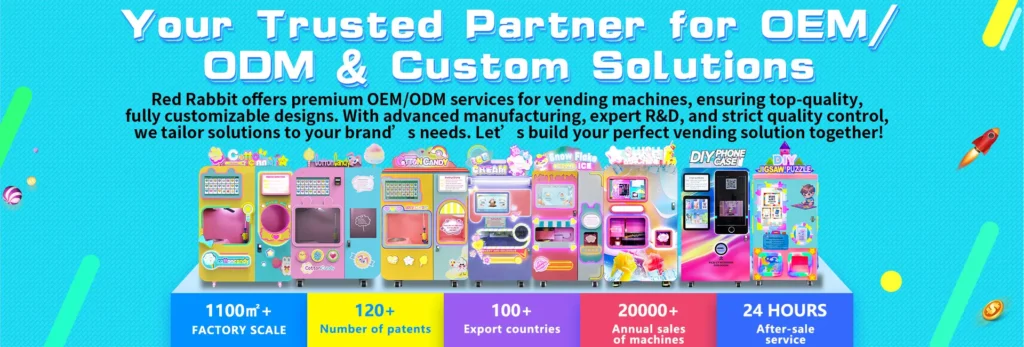
If you’re scaling beyond a handful of machines, consider OEM customization. Red Rabbit offers full branding services: custom exterior colors and logos, branded voice interactions, custom screen UI, and branded packaging. When customers start recognizing your machines across multiple locations, you’ve built something more valuable than a collection of vending machines—you’ve built a brand.
Common Mistakes First-Time Operators Make
- Buying the machine before securing the location. Find the spot first. Then buy the machine that fits it.
- Underpricing. New operators often price too low, thinking it’ll drive volume. It doesn’t. Price at market rate or slightly above. Perceived value matters more than absolute price.
- Ignoring maintenance. A dirty machine repels customers. Clean the exterior weekly. Check the self-cleaning system. Replace any worn parts immediately.
- Putting all machines in one location type. Diversify. One mall, one school, one tourist spot. If one location type underperforms, the others compensate.
Ready to launch? Browse Red Rabbit’s full lineup of high-profit vending machines—factory-direct pricing with global shipping. Not sure which machine fits your goals? Contact the team for a free consultation.