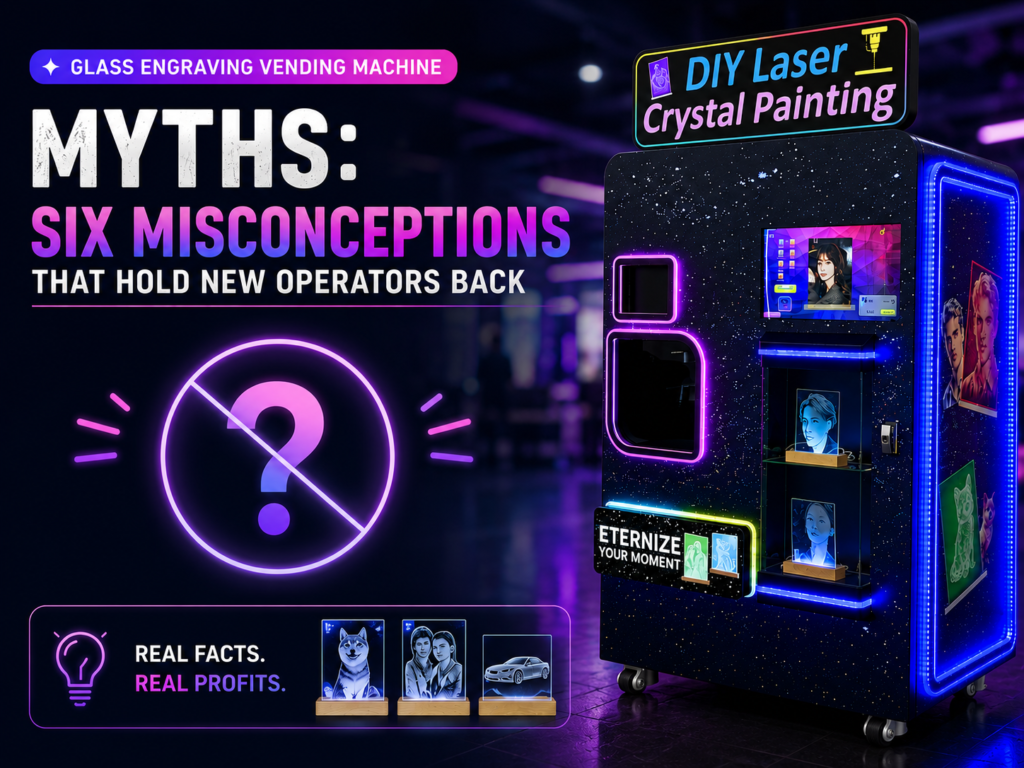
Last month a buyer asked me a question that comes up at almost every trade show. He wanted to know if our glass engraving machine could put a customer’s photo inside a solid crystal cube, the way the fancy 3D laser blocks in gift shops work. I told him no, and he looked disappointed for about two seconds. Then I explained what the machine actually does, and he ordered two units that afternoon.
That conversation is why I am writing this. There is a thick layer of confusion around glass engraving vending machines, and most of it comes from people guessing instead of asking. Operators lose money not because the machine is bad, but because they believed something wrong about it before they even started. Here are six misconceptions I hear constantly, each one corrected with what I have learned from Red Rabbit operators and from the machines themselves.
Myth 1: It engraves inside the crystal like a 3D laser block
This is the big one, and it is the source of most of the other confusion. A 3D crystal machine fires a laser into the middle of a solid glass block and creates tiny fractures at a single focal point, building a design that floats inside the crystal. Our CT-DK320 does not do that. It engraves the surface of the glass or acrylic, a two dimensional mark on a flat or gently curved face.
The distinction matters because the two machines suit different budgets and different locations. A 3D interior engraving unit is expensive, slower per piece, and needs a steady supply of blank crystal blocks. A surface engraving machine is faster, works on inexpensive flat glass and acrylic stock, and fits the price points people actually pay at malls, boardwalks, and tourist spots. When you understand that this is a surface machine, the whole business model stops looking mysterious and starts looking like a vending operation with a high perceived value product.
Myth 2: A laser machine is dangerous and needs special licensing
People hear the word laser and picture an open beam and a stack of permits. The reality is different. A retail vending machine keeps the laser fully enclosed inside the cabinet, with interlocks that shut it down the moment a door opens. Customers never touch the beam. Operators do not wear goggles to load stock. The safety thinking that matters is the same common sense you apply to any electrical appliance: keep the area clear, keep the glass panel clean, and never defeat the safety switches.
If you want the technical background, the Occupational Safety and Health Administration publishes laser hazard guidance on its laser hazards page. The short version is that enclosed, class limited systems designed for retail use are a solved safety problem. The machine is not a welding rig. It is a vending cabinet with a light inside.
Myth 3: Engraving is too slow to make real money
This one survives because people imagine a jeweler hunched over a workbench. A vending engraver is automated. The customer picks a design or uploads a photo on the touchscreen, pays, and watches the machine do the work while they browse. Cycle times are short enough that a customer at a busy location rarely lines up for long, and the product’s value far exceeds the raw material cost.
Speed is also about labor. The operator is not standing there engraving each piece by hand. The machine sells, engraves, and dispenses on its own. One person can run several machines across several locations, which is where the real leverage is. When operators complain about slow, they are usually describing a slow location, not a slow machine.
Myth 4: It only works on one kind of glass
The word glass is in the name, but it undersells the machine. The CT-DK320 engraves glass and acrylic equally well, which means you can sell personalized keepsakes, awards, photo frames, keychains, and small plaques from the same cabinet. Operators who only stock one blank type leave money on the table. The smart ones rotate stock by season: hearts and names before Valentine’s Day, family names during summer tourist season, and simple decorative pieces in between.
This flexibility is also why the machine survives in so many different venues. A mall kiosk, a boardwalk arcade, a museum gift shop, and an airport concourse can all run the same hardware with different product mixes. You are not buying a single use machine. You are buying a small personalization studio that happens to fit in a cabinet.
Myth 5: Nobody pays for custom engraving anymore
The opposite is true, and it has only gotten stronger. People do not pay for an object. They pay for the moment it captures. A couple who engraves their anniversary date onto a glass photo frame is not comparing your price to a mass produced frame on a shelf. They are buying a keepsake, and keepsakes are emotional purchases that ignore price tags.
Personalization is the engine. A name, a date, a photo, a short message, these small customizations are what turn a blank piece of glass into something a customer keeps on a desk for years. Generic gifts are forgettable. Custom gifts get kept. That is the entire economics of this machine in one sentence.
Myth 6: The machine needs constant maintenance
A vending machine is not a car. The engraving laser itself has no mechanical parts that wear out the way a printer head or a motor does. The things that need attention are the same as any vending unit: keep the glass and lens clean, keep the stock loaded, and keep the bill acceptor and touchscreen free of grime. Most service calls operators report turn out to be a dirty lens or a jammed blank, both fixable in minutes.
The best operators build a ten minute end of day routine and a monthly deep clean, and that is about it. Compared to food vending, which brings refrigeration, perishable stock, and food safety inspections, a glass engraving machine is one of the lowest maintenance machines you can place.
Separating the myths from the machine
Every one of these misconceptions dissolves the moment you watch the machine run for five minutes. It engraves the surface, it is enclosed and safe, it is fast, it handles glass and acrylic, customers love personalization, and it does not demand constant attention. The gap between what people fear and what the machine actually is, that gap is where the opportunity sits.
If you are weighing a glass engraving machine against another product line, the glass engraving machine page walks through the hardware in detail. And if you want a straight answer about whether your location fits, rather than another guess, talk to us. The questions that matter about this machine already have answers, and they are not the answers most people expect.