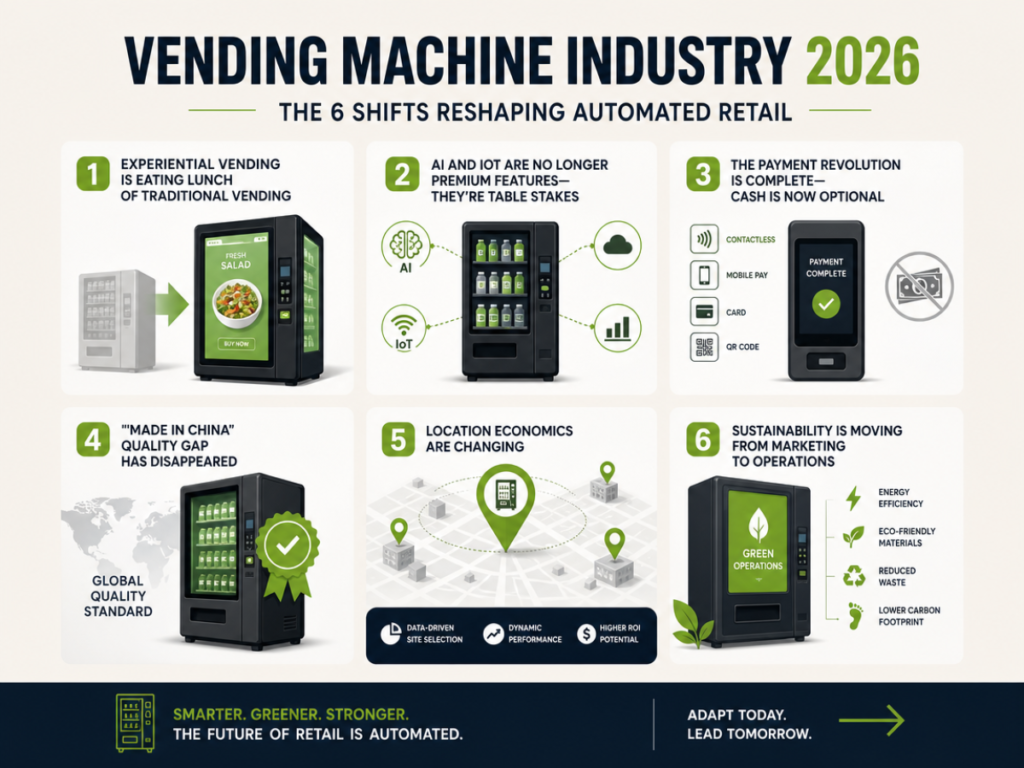
If you looked at the vending machine industry in 2019 and then looked at it again in mid-2026, you’d think someone had replaced the entire sector while you weren’t watching. Snack machines dispensing chips and soda still exist, of course — but they’re no longer where the growth is. The story of 2026 is experiential vending: machines that make, build, create, and prepare rather than just dispense.
I’ve spent the first half of this year tracking the vending machine industry across trade shows, operator conversations, and supply-chain data from Southeast Asia to the Middle East. The shifts are real, they’re accelerating, and they have direct implications for anyone considering putting capital into automated retail. Here are the six trends that matter most.
1. Experiential Vending Is Eating Traditional Vending’s Lunch
The numbers are unambiguous. Traditional snack and beverage vending — the office break room, the hospital corridor, the university hallway — is growing at roughly 3–5% annually in developed markets. Experiential vending — machines that make cotton candy, cook pizza, shave snowflake ice, print custom phone cases — is growing at 18–25% annually, depending on the subcategory.
Why? Three reasons, none of them complicated:
Margin structure. A bag of chips vends for $1.50 and costs the operator $0.70. That’s a 53% margin, and it’s been that way for decades. A cup of cotton candy vends for $7 and costs $0.21. The traditional vending operator looks at those numbers and either switches categories or goes home.
The experience gap. Nobody watches a snack machine. People watch cotton candy machines, pizza robots, and automated ice cream makers. The machine itself becomes the marketing. Foot traffic converts at higher rates because the product — and the process of making it — draws attention. One operator in Jakarta told me his cotton candy machine has a higher conversion rate than the snack machine next to it by a factor of three, despite being more expensive per transaction.
Social media gravity. When was the last time someone posted a photo of a bag of Doritos from a vending machine? Now compare that to how often people post videos of robot-made cotton candy or fresh snowflake ice. Experiential vending machines generate organic social content. Traditional vending machines don’t. That’s not a feature gap. That’s two entirely different categories of retail.
For operators evaluating where to invest in 2026, the message is increasingly clear: the snack vending business is mature, stable, and low-margin. The experiential vending business is young, accelerating, and structurally more profitable per unit of footprint. If you have one location and one machine budget, the experiential option will almost always outperform the traditional one over a 24-month horizon.
2. AI and IoT Are No Longer Premium Features — They’re Table Stakes
Three years ago, a vending machine with remote monitoring was an upgrade. Today, at least in the experiential segment, a machine without IoT is essentially unsellable. The market has crossed a threshold where operators expect real-time data as a baseline, not a luxury.
What this looks like in practice: machines shipping from manufacturers like Red Rabbit now include cloud-connected dashboards as standard. Operators see daily sales volume, inventory levels, temperature readings, error codes, and payment processing data — all from a phone. A notification pings when sugar runs low or a cooling system drifts out of range. No more driving to a location to discover a machine has been down since Tuesday.
AI is starting to layer on top of this. Early implementations include: – 动态定价: machines that automatically adjust prices based on time of day, foot traffic patterns, and historical demand data. A cotton candy machine that charges $7 at 2 PM on a Tuesday and $9 at 7 PM on a Saturday, without operator intervention. – Predictive restocking: algorithms that forecast when consumables will run out based on usage patterns, weather data, and local event calendars — so operators can plan refill routes more efficiently. – Computer vision for quality control: cameras inside production chambers that detect when a product doesn’t meet quality standards and trigger a re-make or operator alert.
None of this is science fiction. The CT-606 cotton candy machine includes AI standby functionality that reduces power consumption during idle periods by learning usage patterns. The next generation of machines will have these features built into the base price, not offered as add-ons.
For operators, the implication is straightforward: a machine bought in 2026 without IoT and AI capabilities will look dated by 2028. Don’t buy yesterday’s technology.
3. The Payment Revolution Is Complete — Cash Is Optional Now
Between 2020 and 2026, the vending machine industry completed a payment transformation that had been creeping forward for a decade. Contactless payments — tap-to-pay cards, Apple Pay, Google Pay, QR code scanning — are now the default expectation in developed markets.
The data from operators is unambiguous about the cost of cash-only operation:
- An operator in Manila tracked customers who approached a cash-only cotton candy machine, read the screen, and walked away. His estimate: roughly 40% of potential sales lost because the machine wouldn’t accept cards or mobile payments. Adding a card reader cost $150. Sales tripled within two weeks.
- A Dubai operator reported that 78% of his cotton candy machine transactions were contactless — mostly Apple Pay from tourists. His machine was placed near a hotel, and the tourist demographic simply doesn’t carry local cash.
- In a survey of 200 experiential vending operators across five countries, those offering 3+ payment methods (cash, card, QR, NFC) averaged 34% higher monthly revenue than cash-only operators — even after controlling for location quality.
The bottom line for 2026: if your machine only takes cash, you’re leaving roughly one-third to one-half of your potential revenue untapped. The processing fees — typically 2–3% per transaction — are a rounding error compared to the lost sales. All major experiential vending manufacturers now ship machines with multi-payment support as standard. There’s no excuse for cash-only in 2026.
4. The “Made in China” Quality Gap Has Closed
Five years ago, a Chinese-manufactured vending machine carried a stigma. Operators expected reliability issues, parts shortages, and rough-around-the-edges build quality.
That era is over.
Manufacturers like Red Rabbit (Chituvem) have invested heavily in certifications that matter: CE, UKCA, RoHS, FCC, and NAMA. Their machines ship to 130+ countries with warranty support and remote diagnostics. A Red Rabbit cotton candy machine undergoing a technical fault in a Dubai mall can trigger a diagnostic alert to the manufacturer’s support team in Guangzhou within seconds — and the operator in Dubai sees the same alert on their phone.
The competitive dynamic has shifted. Five years ago, the choice was: buy a reliable but expensive Japanese or European machine, or buy a cheap but questionable Chinese one. Today, the choice is: buy a certified Chinese machine with global support infrastructure at 40–60% of the price of a European equivalent. The quality difference no longer justifies the price difference for most operator use cases.
This is particularly relevant for the experiential vending segment, where Chinese manufacturers have been first-movers. Cotton candy machines, puzzle printers, snowflake ice units, and phone case customizers from Chinese factories are now the global standard. The European and Japanese competitors — where they exist — are playing catch-up on features while charging premium prices for brand names that don’t necessarily correlate with better uptime or support.
5. The Location Economics Are Shifting
Mall operators and retail landlords have noticed the experiential vending trend, and they’re responding — but not always in ways that benefit machine operators.
What’s changing:
Malls are becoming more selective about which machines they accept. A few years ago, any vending machine was welcome. Today, malls want machines that are visually attractive, draw foot traffic, and contribute to the “mall experience” rather than detract from it. A beaten-up snack machine in a premium mall corridor is increasingly unacceptable. A clean, LED-lit cotton candy machine with a crowd around it is exactly what malls want.
Revenue-share models are becoming more common than flat rent. Mall operators see the per-square-foot revenue an experiential machine generates and want a piece of upside. Revenue shares of 15–25% are becoming the norm for premium locations. This changes the operator’s math: at low volume, flat rent is better; at high volume, revenue share costs more. The smart operators negotiate a hybrid — flat rent with a revenue-share kicker above a certain threshold.
Non-traditional venues are opening up. Hotels, airports, hospitals, university campuses, and corporate offices are increasingly willing to host experiential vending machines. These venues typically have lower or no rent, but access is relationship-driven — the operator needs to network, pitch, and negotiate rather than simply responding to a mall’s open call for vendors. The operators building relationships with venue managers across multiple categories are the ones expanding fastest.
6. Sustainability Is Moving from Marketing to Operations
Sustainability in vending used to mean “we use recyclable cups.” In 2026, it’s becoming a more substantive operational concern — not because operators necessarily care deeply about the environment, but because venues and consumers increasingly do.
Three practical implications for operators:
Energy consumption matters to venue managers. A machine that draws 400W in standby and 2,500W during production costs $30–$60/month in electricity at average commercial rates. But beyond cost, some mall operators in Europe and parts of Asia are beginning to ask for energy consumption data as part of the vendor approval process. A machine with AI standby functionality that reduces idle consumption by 30–40% isn’t just saving the operator money — it’s making the venue manager’s sustainability report look better.
Packaging waste is under scrutiny. Single-use plastic cups and sticks are facing regulatory pressure in multiple markets. The EU’s Single-Use Plastics Directive is pushing venues toward biodegradable or reusable alternatives. Operators who plan for this — switching to paper-based sticks, compostable cups, or incentivizing customers to bring their own containers — will have an easier time renewing venue contracts in 2027 and beyond.
Food waste is becoming a compliance issue. In some jurisdictions, unsold prepared food products from vending machines are subject to the same waste-disposal regulations as restaurant food waste. This hasn’t yet affected most experiential vending categories (cotton candy doesn’t spoil; puzzle paper doesn’t expire), but it’s on the radar for machines that handle perishable ingredients — ice cream, fresh food, and certain beverage units. Operators in those segments should understand their local food-waste regulations before deploying.
What This Means for Operators in the Second Half of 2026
If you’re evaluating an investment in automated retail right now, the landscape is more favorable than it has been at any point in the past decade — but it’s also more competitive. The easy money from being “first to market” with an experiential machine in a given mall is fading as more operators enter the space.
The operators who will do well in the back half of 2026 share a few characteristics:
They think in terms of location portfolios, not individual machines. One machine in one mall is a side hustle. Three machines across three different venue types — a mall, an amusement park, a hotel — is a business with hedged risk. The successful operators plan for machine #3 before machine #1 has paid for itself.
They prioritize IoT/data capabilities when buying machines. A machine without remote monitoring requires more drive time, more guesswork, and more unplanned downtime. The cost savings from a cheaper, non-connected machine disappear within the first year of operation.
They build relationships with venue managers rather than just responding to listings. The best locations rarely appear on a public vendor board. They’re filled through relationships, referrals, and proactive pitching. The operators spending 20% of their time on networking and venue development consistently outperform those spending 100% of their time on operations.
They’re testing multi-machine strategies within single locations. Placing a cotton candy machine and an ice cream machine side by side in the same mall kiosk nearly doubles revenue without doubling rent. The expansion path with the best ROI isn’t opening a second location — it’s maximizing the first one.
常见问题
Is 2026 a good time to enter the vending machine industry? For experiential vending — cotton candy, ice cream, puzzle printing, snowflake ice — yes. The market is growing fast, machine quality has matured, and consumer acceptance of automated food preparation is at an all-time high. For traditional snack and beverage vending, growth is steady but slow, and margins are under pressure.
What’s the most profitable vending machine category right now? Cotton candy vending machines consistently show the highest per-unit margins (94%+ gross), followed closely by puzzle printing and snowflake ice. The “best” category depends on your location type: cotton candy works everywhere families gather, snowflake ice needs warm-weather markets with dessert culture, puzzle machines need tourist or family traffic.
How long does it take to break even on an experiential vending machine? In a good location: 30–60 days for cotton candy, 60–90 days for puzzle machines and snowflake ice. In an average location: 3–5 months. In a poor location: 6+ months or indefinite. Location quality determines break-even speed more than machine cost or product type.
Do I need special licenses or permits? Most experiential vending machines require basic food-handling permits. Machines with certifications (CE, UKCA, RoHS, NAMA) simplify compliance compared to manual food operations. Check with your local health authority.
What’s the biggest mistake new operators make? Rushing into a location without spending time observing foot traffic patterns. The operators who succeed spend days — sometimes weeks — watching how people move through a venue before committing to a spot. A machine 30 feet closer to a play area can earn 3x more than the same machine near an escalator.
Evaluating vending machine options? Red Rabbit manufactures experiential vending machines across five categories: cotton candy, ice cream, snowflake ice, slush, and custom printing. Browse the full product line 或 contact our team to discuss which machine fits your target market.