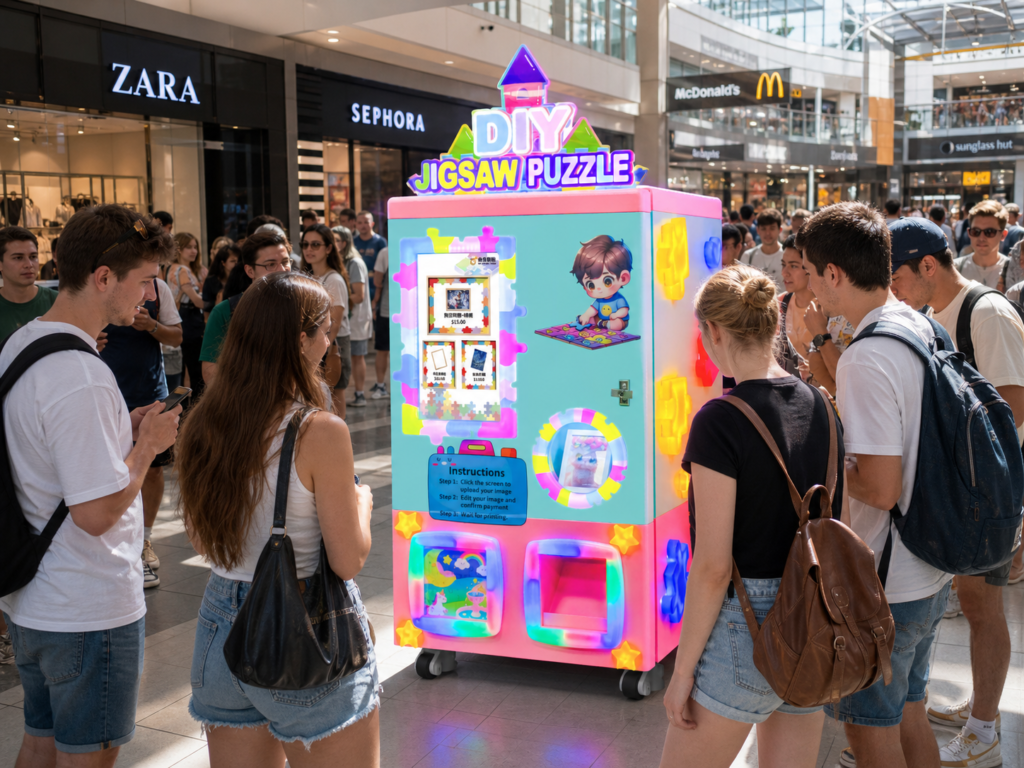
There’s a jigsaw puzzle vending machine in a castle gift shop in Bavaria that out-earns the shop’s entire postcard and magnet section combined. The shop manager told me something I haven’t forgotten: “Postcards get thrown away. Puzzles get framed.” She was annoyed about it, actually—her margin on postcards is higher per unit. But the machine moves 9–12 puzzles per day at €22 each, and the customers do all the work themselves.
I’ve been skeptical of automated retail concepts that sound too clever. A machine that prints custom photo puzzles while you wait? Sounds like something that works at a trade show and nowhere else. I was wrong. The Red Rabbit CT-PTJ370—that box in the castle gift shop—is quietly one of the better ROI machines in the entire vending category, and almost nobody talks about it because it’s less flashy than a cotton candy robot.
Here’s what it actually does, how much money it makes, and why it’s worth considering if you have access to any kind of tourist traffic.
The Product People Actually Buy
A customer walks up to the touchscreen. They upload a photo from their phone—family portrait, vacation snapshot, pet picture, whatever. They choose a puzzle piece count: 30-piece for kids, 100-piece for casual puzzlers, 500 or 1,000 for the serious crowd. The machine prints the image onto puzzle board, die-cuts the pieces, and drops the finished puzzle into the collection tray. The whole cycle takes maybe five minutes.
The finished product is a real jigsaw puzzle in a branded box with the customer’s own image on the lid. It is not a cheap novelty. The puzzle board is proper thickness. The cutting is clean. Pieces fit together. This is a product someone pays $20–$35 for and feels like they got their money’s worth.
What makes this work commercially is the emotional hook. A generic puzzle of the Eiffel Tower is a commodity. A puzzle made from your family’s photo in front of the Eiffel Tower is a keepsake. The difference isn’t the puzzle quality—it’s the personal relevance. And personal relevance is what lets you charge $25 for something that costs $2 to make.
The Unit Economics
| Артикул | 30-piece | 100-piece | 500-piece |
|---|---|---|---|
| Photo frame + print paper | $0.80 | $0.80 | $0.80 |
| Ink per print | ~$0.40 | ~$0.40 | ~$0.40 |
| Box + packaging | $0.30 | $0.30 | $0.30 |
| Total material cost | $1.50 | $1.50 | $1.50 |
| Typical selling price | $15 | $22 | $35 |
| Gross profit | $13.50 | $20.50 | $33.50 |
The material cost is nearly flat regardless of piece count. The die-cutting takes the same amount of time. What changes is the perceived value, and that’s a beautiful thing when you’re the one setting prices.
A machine doing 10 puzzles per day at an average of $22 generates $205 in daily gross profit. That’s $6,150 a month. Subtract $500 for location rent. Subtract another $80 for electricity and basic maintenance. You’re clearing about $5,500 a month from a machine that cost $5,300–$6,500. Payback in 4–6 weeks is standard for well-placed units.
Location Strategy: Where This Machine Belongs
The jigsaw puzzle vending machine has a narrower location range than food vending machines, but within that range, it crushes. Here’s the hierarchy, based on operator data I’ve collected.
Tourist Attractions (Castles, Museums, Landmarks, Theme Parks)
This is the machine’s natural habitat. Tourists seek souvenirs that don’t feel mass-produced. A custom puzzle of your own photo at Neuschwanstein Castle beats any factory-made snow globe. The conversion rate at tourist locations is unusually high—my estimate is 1–3% of passing foot traffic, compared to 0.3–0.8% for a cotton candy machine in the same environment. Lower impulse appeal, but dramatically higher spend per transaction.
A Red Rabbit operator in a European landmark gift shop reported 9–12 daily orders at an average of €22. Monthly net, after 15% revenue share and materials: approximately €4,200 during peak season. Annual net from that single location: roughly €28,000 counting the shoulder seasons.
Family Entertainment Centers
Bowling alleys, arcades, indoor play centers. Families with kids aged 5–12 are the target demographic. A puzzle of the family photo from today’s outing becomes the souvenir of the day. At $15–$22, parents see it as a better value than the $8 plastic toy their kid will forget about by tomorrow.
One operator placed a machine in a UK family entertainment center and found an unexpected benefit: the puzzles generate social media posts. “Parents photograph the finished puzzle and tag the venue,” he told me. “The venue loves it. It’s free marketing for them, which makes them more motivated to keep the machine in a prime spot.”
Gift Shops at Scenic Spots
Lookout points. Botanical gardens. Zoo exits. These are places where people have just taken photos and are in the mood to commemorate the experience. A puzzle machine near the exit captures that moment. The sales pitch is not “buy a puzzle” but “turn that photo you just took into something you’ll keep.” The conversion psychology is different and, from what I’ve seen, more effective.
Where It Fails
Bus stations. Supermarket entrances. Office building lobbies. The machine needs people who are in leisure mode with time to spare. Rush-hour commuters are not that audience. Neither are people buying groceries. I’ve seen operators try these locations and pull the machine within two months. The machine works; the mindset of the foot traffic matters more than the raw volume.
The Technology That Makes It Reliable
The CT-PTJ370 stores 150 photo frames and 100 sheets of print paper, enough for roughly two weeks of moderate-volume operation between restocks. It uses four base colors of ink (CMYK), 500ml each. One complete ink set handles about 1,000 prints. At 10 puzzles a day, that’s three months of operation per ink set at a cost of $160—or about $0.16 per print in ink.
The die-cutting mechanism is the part I worried about most when I first looked at this machine. Die-cutting is mechanical. Mechanical things jam. But Red Rabbit’s system uses a self-cleaning cutting mechanism that’s been in the field for several years now. The operators I talked to reported minimal jamming issues—maybe once every 300–400 puzzles, and resolved in under two minutes.
The machine connects to the same IoT dashboard as every other Red Rabbit product. Inventory tracking tracks both blank materials and ink levels. When you’re running low on 500-piece blanks, you get a notification. When ink dips below 20%, you get a notification. You never physically check the machine without knowing exactly what needs restocking.
A Use Case Most Operators Miss: Corporate and Event Markets
Here’s something I stumbled across talking to a Red Rabbit operator in Singapore. Six months after placing his machine in a mall, a corporate event planner approached him about renting the machine for a company family day. The deal: $800 for the day plus material costs. The machine produced 40 puzzles over six hours. The company paid. The employees loved it. The operator netted about $1,200 for one Saturday.
He’s since added “event rental” as a secondary revenue stream. Corporate family days. Wedding receptions. School fundraisers. The machine is portable—it fits through standard doorways and runs on a standard power outlet. For events, he charges a flat rental fee plus per-puzzle pricing, and lets the event organizer handle the customer interaction.
This use case doesn’t show up in standard vending machine ROI calculations because most operators never think about it. But it changes the economics meaningfully. A machine that generates $5,000/month from a fixed location and another $800–$1,500/month from weekend rentals is a different asset than one that just sits in a mall.
Getting Started
- Secure the location before ordering the machine. This is rule number one for puzzle machines because the location type so heavily determines success. A puzzle machine in a tourist gift shop is night-and-day different from one in a regular retail corridor.
- Test the machine with your own photos. The first engraving I saw was a Red Rabbit team member’s cat photo. It looked great. Test your machine with real customer scenarios—family photos, landscape shots, pet portraits—so you know what to expect when customers ask about quality.
- Stock variety in puzzle sizes. The data from operators is consistent: 30-piece puzzles sell to families with young children. 100-piece is the volume leader. 500 and 1,000-piece options attract the enthusiast crowd and anchor the premium price point. Don’t only stock one size.
- Use the IoT dashboard religiously. The machine tracks which sizes sell best at which times. After two months, you’ll have clear data on whether your location skews toward quick 30-piece impulse buys or deliberate 500-piece keepsakes. Stock accordingly.
Ready to explore puzzle vending? Browse Red Rabbit’s jigsaw puzzle vending machine with factory-direct pricing, global shipping, and a dedicated support team. Want to see profit projections for your specific location? Свяжитесь с нами for a free consultation.