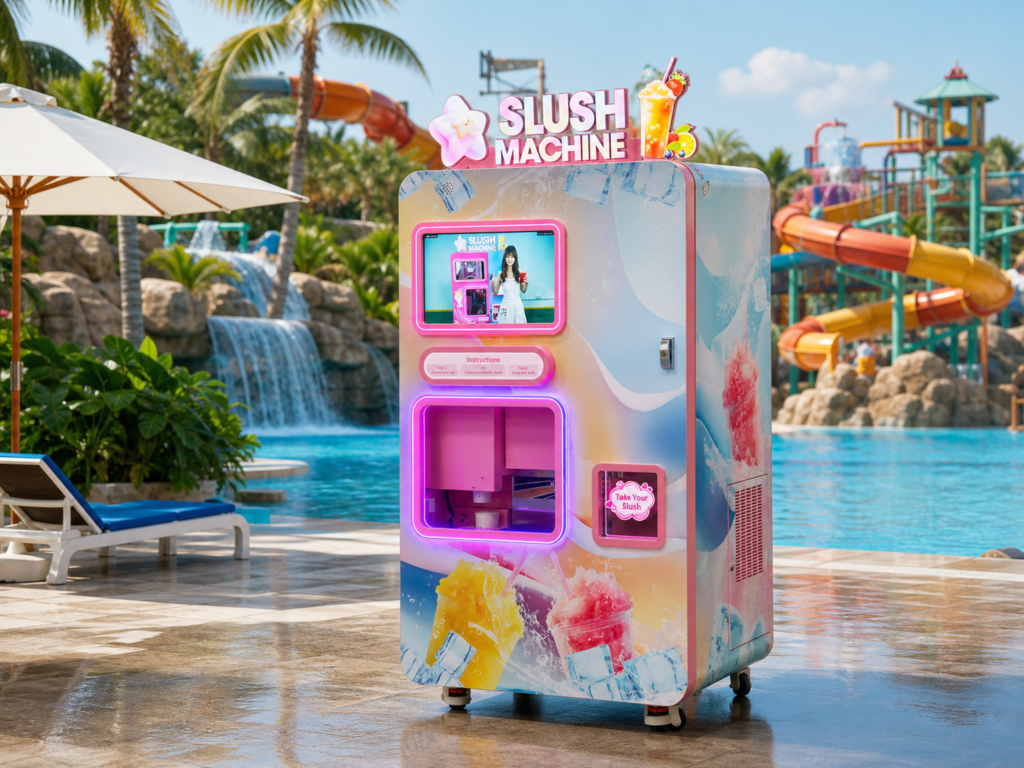
私が実際に稼働しているのを見た中で最も収益性の高いベンディングマシンは、皆さんが想像するものではありません。コットンキャンディロボットでもスマホケースプリンターでもありません。それは、 スラッシュ自販機 at a water park in Southeast Asia. The machine sits ten meters from the wave pool exit. On a hot Saturday in July, it moves 60 cups an hour. Sixty. At $5 a cup. With ingredient costs running about $0.60 per serving.
I asked the operator—a guy who owns twelve machines across four water parks and beach resorts—what he likes about slush machines versus his ice cream units. He didn’t hesitate. “Ice cream needs two flavors and toppings to feel right. Slush just needs to be cold and sweet. One flavor, one machine, no decisions. People walk past, they’re hot, they buy.”
彼の心理学についての見解は正しいですが、スラッシュマシンがビジネスとしてこれほどうまく機能する理由は他にもあります。以下が全体像です。.
冷凍ドリンク自販機の超シンプルな経済学
I’m going to lay out the numbers first because they’re the best part of this story. A slush vending machine—Red Rabbit’s CT-410 model—holds 12 liters of mix, dispenses 80 cups before needing a refill, and produces a finished drink in 40 to 90 seconds. The ingredient math is almost boring in its simplicity.
| 品目 | コスト |
|---|---|
| Slush mix per 12oz serving | $0.25–$0.35 |
| カップ+フタ+ストロー | $0.08–$0.12 |
| Electricity per serving | ~$0.02 |
| Total cost per drink | $0.35–$0.49 |
| 一般的な販売価格 | $4–$7 |
| Gross profit per drink | $3.51–$6.65 |
At 20 drinks a day—a slow weekday at a mediocre location—you’re looking at about $80 in daily profit. $2,400 a month. At 40 drinks a day—a solid location on a summer weekend—about $200 daily, $6,000 a month. At 60 drinks an hour during peak water park hours, the machine clears $250–$350 in that hour alone.
The machine cost runs $4,380–$5,500. Even at the conservative 20-per-day number, you recover the investment in about 8–10 weeks of summer operation. At 40 per day, you’re looking at 4–5 weeks. I’ve seen operators in beach locations hit payback in under three weeks during peak season.
季節性の現実(そしてそれが問題ない理由)
Let’s address the obvious objection: slush is seasonal. Nobody orders a frozen drink in January in Chicago. This is true, and it matters, but less than most new operators assume.
First, seasonal doesn’t mean four months of work and eight months of nothing. A machine in an indoor mall, cinema, or year-round tourist destination operates 365 days. The seasonal problem applies to outdoor locations in cold climates, not to the entire product category.
Second, even for seasonal outdoor locations, the math still works. A machine that generates $6,000/month for five summer months and $800/month for seven off-season months produces $35,600 a year. After subtracting $5,000 for the machine and maybe $8,000 in materials and rent, that’s $22,600 in net profit from a $4,380–$5,500 investment. Show me another business with those first-year numbers and I’ll show you one with a lot more headaches than filling a slush tank once a week.
Third, slush machines pair beautifully with other seasonal machines to create year-round income. A water park slush machine that crushes it June through August can be complemented by a cotton candy machine in an indoor location that performs November through March. Different seasons, different machines, same operator, steady year-round cash flow.
Flavor Strategy: One vs. Two Flavors
Red Rabbit’s CT-410 holds two flavor tanks plus three topping options. Operators are split on whether to use both tanks or run the machine single-flavor.
The single-flavor camp argues simplicity. “Less to clean, less to stock, less to go wrong,” one operator told me. “I run blue raspberry all summer. Kids see blue, they want blue. Nobody asks for mango.” His machines average 25–30 cups a day at beach locations.
The dual-flavor camp argues conversion. “Some people don’t like blue raspberry,” another operator countered. “Offering strawberry alongside captures the 20% who would have walked past.” His machines average 30–35 cups a day in comparable locations.
My take: if you’re in a high-traffic location where volume is the priority, run two flavors. The additional complexity is marginal and the conversion uplift is real. If you’re in a moderate-traffic location or this is your first machine, start with one flavor. Master the operation, then add variety.
The three toppings—typically sprinkles, popping boba, and fruit pieces—are worth including regardless of your flavor count. They’re visual. Kids point at them. Parents buy them. The topping adds maybe $0.03 in cost and $0.50–$1.00 in price premium. That’s a margin decision that makes itself.
スラッシュマシンが置かれるべき場所
ウォーターパークとビーチ:自然な生息地
ここはスラッシュマシンが最高の形で力を発揮する場所です。暑さ、人混み、そしてまさにその環境のために設計された商品。特にウォーターパークはほぼ完璧なスラッシュ販売エリアです。囲い込まれた客層、予測可能なピーク時間帯、そしてすでに濡れていて雫も気にしない顧客層が揃っています。.
The operator I mentioned earlier—the one with twelve machines—placed his first unit at a mid-size water park in Thailand. First month, during the tail end of rainy season: 22 cups a day, $3,300 in revenue. Second month, as summer kicked in: 48 cups a day, $7,200. By his third summer season at that park, the single machine was generating over $10,000 a month during July and August.
映画館:屋内の金鉱
映画館のスラッシュ販売は予測可能なリズムに従います。午前10時から午後2時までは閑散、午後2時から午後6時までは中程度、午後6時から午後10時までは爆発的。コンセッションスタンドの近くに設置されたマシンは、映画館自身のフファウンテンソーダと競合することなく、映画前のドリンク需要を取り込みます——異なる商品、異なる顧客です。.
英国のマルチプレックス映画館のあるオペレーターは、平日平均18~22杯、週末35~40杯と報告しました。平均取引額:£3.50。家賃と材料費を差し引いた月間純利益:およそ£2,800。映画館の経営陣は、追加スタッフがゼロで、既存のコンセッション収入に加えて収益分配が生まれるため、これを気に入っています。.
モールとファミリーエンターテインメントセンター
屋内モールは温度が管理されており、家族が何時間もぶらぶらするためうまく機能します。重要な設置の洞察:マシンはフードコートではなく、エスカレーターや子供の遊び場の近くに置くこと。フードコートにはすでに飲料の選択肢があります。エスカレーターの踊り場は滞留時間を生みます——人が立ち止まり、子供がカラフルなスラッシュディスプレイに気づき、販売が成立します。.
スラッシュマシンが苦戦する場所
Office buildings. Transit stations during non-summer months. Outdoor locations without shade or shelter. The machine needs ambient heat or leisure context to trigger purchase intent. A slush machine in an air-conditioned office lobby in November is a very expensive decoration.
メンテナンスの現実
Slush machines require more cleaning than cotton candy or phone case machines. This is the honest trade-off that most manufacturer documentation glosses over. The mixing tank needs rinsing between flavor changes. The dispensing nozzle needs daily wiping. If you skip maintenance for a week, the machine still works but the product quality degrades noticeably.
The good news: Red Rabbit’s CT-410 has a self-cleaning cycle that handles most of the internal plumbing. The operator’s weekly routine is about 45 minutes: drain residual mix, run the cleaning cycle, wipe external surfaces, refill with fresh mix. That’s it. The machine alerts you through the IoT dashboard when it’s time for deeper maintenance—usually every 3–4 months for a full system flush.
スラッシュドリンクを販売する従来のコンセッションスタンドは営業時間ごとにスタッフが必要ですが、それと比べると、自販機版のメンテナンス負担はごくわずかです。スタッフ付きのスラッシュスタンドは、パートタイムの人員確保のために月およそ$1,500~$2,000の人件費がかかります。マシンは週45分の手間で済み、病欠もありません。.
スケーリング:あるオペレーターが12台のスラッシュ帝国を築いた方法
The water park operator I mentioned started with one machine. Today he has twelve. His playbook is worth studying:
フェーズ1(マシン1~3):モデルを証明する。. He placed machines at three different water parks within a two-hour drive of each other. Different sizes, different demographics. He tracked per-machine metrics obsessively and identified which park type performed best.
フェーズ2(マシン4~6):クラスター化と最適化。. 彼は最も成果の良いパークタイプに追加のマシンを設置し、ウェーブプール、流れるプールの出口、子供の水遊びエリアの近くにクラスター化しました。すべての拠点分をまとめて注文することで、スラッシュミックスのボリュームディスカウントを交渉しました。.
フェーズ3(マシン7~12):隣接する会場へ拡大。. ウォーターパークのモデルが証明され文書化されると、彼は既存マシンの実績データを持ってビーチリゾート、ホテルのプール、屋外イベント会場にアプローチしました。「もうマシンを売り込んではいません」と彼は私に言いました。「他の拠点の平方フィートあたりの収益を見せて、その一部を欲しがるか尋ねるんです。ほとんどの人がイエスと言います。」“
His twelve machines collectively generate roughly $35,000–$45,000 a month during peak summer months. He spends about 20 hours a week on the business—driving between locations, restocking, chatting with venue managers. His brother handles maintenance and repairs. It’s not passive in the “check your phone once a month” sense, but it’s $400,000+ a year from a business that started with one $4,500 machine.
スラッシュベンディング事業を始める準備はできましたか? Red Rabbitの スラッシュ自販機 with two flavor tanks, three topping options, and full IoT connectivity. Want to calculate your profit potential? チームへのお問い合わせ 対象エリアに基づいたパーソナライズされた予測についてはこちらをご覧ください。.