At a wedding expo last spring I watched a bride upload her engagement photo to a puzzle machine, watch it print in about a minute, then walk off holding a puzzle of the two of them. She paid more for that than for the printed canvas next door, and she was happier. That moment explains the whole appeal of a custom puzzle vending machine. You are not selling a generic product. You are selling the customer’s own life, printed and boxed in ninety seconds.
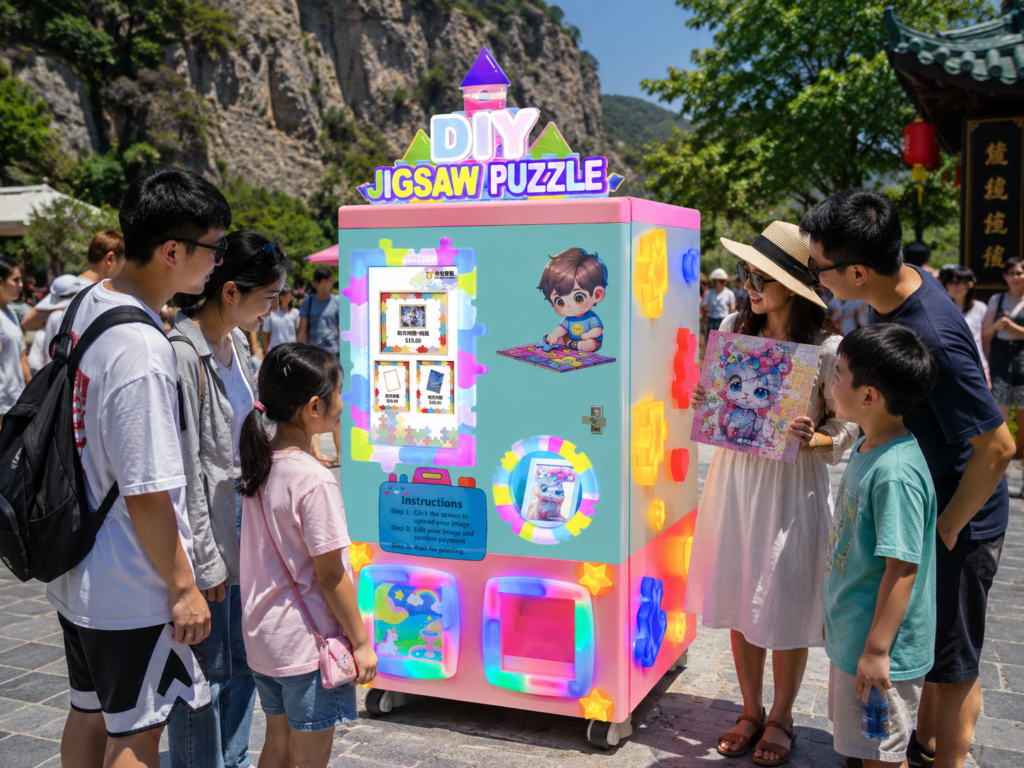
This guide covers what you can actually make on a Red Rabbit PTJ unit, the real material cost behind each item, and how operators price them across malls, tourist sites, and events.
What the machine actually prints
The CT-PTJ370 does not cut anything. It pulls a pre cut puzzle sheet from an internal channel, prints the customer’s photo onto it with a high resolution head, and slides the finished puzzle into the tray. One set of ink prints about 1,000 images, and the paper roll holds 100 sheets. A frame sits in a separate channel and gets added when the customer opts in. Print time runs 60 to 90 seconds.
Because the base is fixed size cardstock, the product is a sturdy puzzle. That is deliberate. It is a twenty to thirty minute family activity, a bag sized souvenir, and something a kid can finish without help. It is not a giant puzzle that ends up in a closet.
The product lineup that sells
There is really one product here: a custom photo puzzle. The customer uploads any picture from their phone, the machine prints it onto a fixed puzzle board, and out it comes. The photo content does not change the cost or the build. A pet shot, a wedding portrait, a graduation photo, a travel memory, a baby’s first year, a family reunion, or a company logo all run through the same paper and ink. What changes the price is where the machine sits, not what is on the puzzle.
So operators do not stock a long list of SKUs. They run two formats, with material cost based on the published consumables: puzzle paper at $0.80 per sheet, ink at roughly $0.25 per print, and frame at $0.80.
| Format | Material cost | Margin |
|---|---|---|
| Standard photo puzzle (any image) | $1.05 | 80 to 90% |
| Framed photo puzzle (any image) | $1.85 | 85 to 90% |
The price for each format is set by location, not by the photo on it. See the channel table below. The same puzzle sold at a wedding venue earns far more than the same puzzle at a mall food court, even though the operator spends the identical $1.05 to make either one. The spot’s emotional context does the pricing work.
How operators set pricing
There is no single right price. Operators test, then hold. The pattern across Red Rabbit sites looks like this:
| Channel | Standard puzzle | Framed | Note |
|---|---|---|---|
| Shopping mall | $9 to $14 | $15 to $20 | Impulse buyers, keep it low |
| Tourist site | $15 to $20 | $22 to $28 | Commemorative mood, higher ceiling |
| Event or wedding | $18 to $24 | $26 to $30 | Captive happy crowd, premium works |
One Chengdu operator tested 68, 78, then 88 RMB over three months. Volume barely moved. He settled at 78 RMB standard and 108 RMB framed, about $11 and $15, and earned an extra $680 a month from the increase alone. The price ceiling is higher than most expect because there is no cheaper substitute for a puzzle with your own photo on it.
From photo to finished puzzle in five steps
The workflow is the same for every product above:
1. Upload. The customer scans a QR code, picks a photo from their phone, or takes one on the spot. A preview shows the finished layout.
2. Choose format. Standard or framed.
3. Print. The arm moves the sheet to the head. Full color, 60 to 90 seconds depending on image complexity.
4. Frame, if chosen. About a third of customers add a frame. The machine pulls it from a separate channel at zero extra labor.
5. Deliver. Finished puzzle slides into the tray. The customer pays and leaves with a keepsake, not a receipt.
Why the frame upsell matters
The frame is the quiet profit engine. It costs the operator about $0.80 and adds $6 to $8 to the sale. If a third of customers take it, that is roughly $2 of pure margin per transaction on average. Across 400 puzzles a month, the frame alone adds $700 to $1,000 with no extra time from the operator. Set the prompt to appear right after photo selection, not buried in checkout, or most people never see it.
Matching the product to the location
The puzzle is one product, but the on screen experience and the price shift with the crowd. At a tourist site the prompt leans toward travel and family photos and the price sits at the higher end. At a mall it leads with kid and pet photos at a lower impulse price. A wedding venue foregrounds engagement and favor themes and charges a premium. A university surfaces club and graduation prompts. The machine and the build are identical. Only the on screen theme and the location based price change, and that takes minutes to set up.
For a wider personalization offer, some operators pair the puzzle unit with a laser engraving machine so the same footprint serves both photo puzzles and etched glass gifts.
Frequently asked questions
Can the machine print anything besides puzzles?
No. It prints only on the puzzle board. But that board takes any photo the customer uploads, a pet, a wedding portrait, a graduation shot, a company logo, so the range of keepsakes is wide even though the format is one.
What size is the puzzle?
Fixed size, roughly 10 by 15 cm up to A4. The fixed format keeps consumable cost predictable and the customer experience consistent.
How much does one puzzle really cost to make?
Around $1.05 in paper and ink for a standard puzzle, or $1.85 with a frame, before rent and card fees. Add about $1.50 of amortized rent and the all in cost lands near $3, which still leaves an $7 to $15 profit at typical prices.
Is the print quality good enough to sell?
It is photo lab grade. Colors are vivid and edges are clean. A blurry or low resolution source photo is the only thing that looks bad, so the screen prompts customers to pick a clear image.
Want the full spec sheet and consumable prices? Browse the Red Rabbit jigsaw puzzle vending machine, then Contacto for machine cost, ink and paper pricing, and shipping to your market.