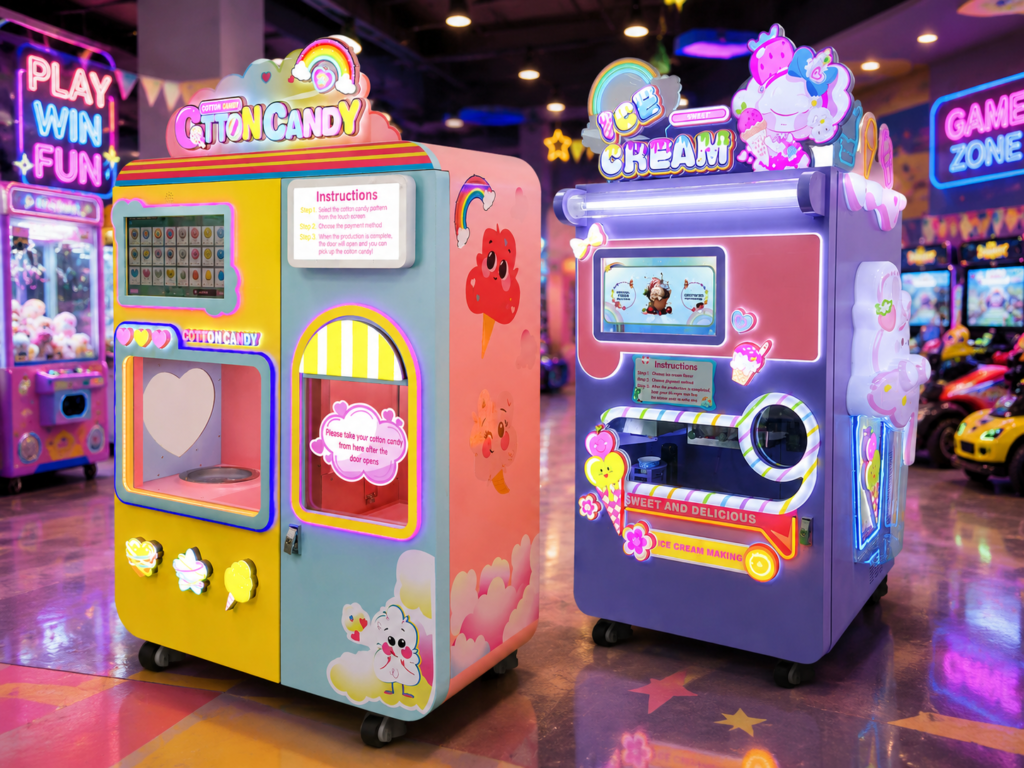
I remember standing in a Birmingham arcade last summer, watching a kid press a touchscreen, pick a unicorn-shaped cotton candy, and grin as the machine whirred to life. Ninety seconds later, he walked away with a 10stickofspunsugar—andthearcadeownerpocketed9.70 in pure profit. That’s the reality of running a negocio de máquinas expendedoras de algodón de azúcar in 2026. Pair it with an ice cream vending machine, and you’ve got a two-headed cash generator that works around the clock while you sleep.
This isn’t a get-rich-quick fantasy. It’s math. And the math is embarrassingly good.
Why Cotton Candy and Ice Cream Vending Machines Are the Perfect Pair
Most vending operators pick one product and call it a day. That’s leaving money on the table. Cotton candy and ice cream machines complement each other in ways that multiply revenue without doubling your workload.
The Numbers Don’t Lie — Profit Margins That Beat Traditional Vending
Let’s get the napkin math out of the way. A standard snack vending machine operates on 30–40% margins. You buy a bag of chips for 0.60,sellitfo1.00, and celebrate your 0.40.Meanwhile,acottoncandyvendingmachineproducesoneservingfoabout0.30 in raw materials—sugar, a stick, and a tiny bit of electricity—and sells it for 7to15. That’s not a margin. That’s a money printer.
Ice cream machines run similar numbers. Raw ingredient cost per serving hovers around 0.50to0.80. Retail price? 4to8, depending on location. Gross margins routinely exceed 85%. When a traditional vending operator is doing backflips over 40%, the automated cotton candy and ice cream crowd is operating in an entirely different league.
A single cotton candy machine placed in moderate foot traffic—think 10 to 15 sales per day—generates roughly 2,100to4,500 in monthly profit after ingredient costs. An ice cream machine in a busy mall food court can push 3,000to5,000 per month. Together, you’re looking at a potential 5,000to9,500 monthly income stream from two machines that require no staff, no storefront, and about two hours of maintenance per week.
Two Machines, One Location Strategy — Maximizing Revenue Per Square Foot
Here’s where it gets interesting. When you negotiate a location deal—say, a corner in a shopping mall or a spot near an amusement park entrance—you’re typically paying a fixed monthly rent or revenue share. Placing two machines in that same footprint nearly doubles your revenue potential without doubling your location cost. The machines don’t compete; they complement. A family walks by. The kid wants cotton candy. The parents want ice cream. Both machines ring up a sale within 30 seconds.
I spoke with a operator in Dubai who placed a cotton candy machine and an ice cream machine side by side in a cinema lobby. His logic was simple: “Kids drag their parents to the cotton candy machine before the movie. Parents treat themselves to ice cream during intermission. Everybody wins.” His combined monthly profit from that single location? $7,200.
Year-Round Demand — Summer Ice Cream, Winter Cotton Candy
Seasonality kills a lot of vending businesses. Hot dog carts die in winter. Hot chocolate machines gather dust in July. But the cotton candy and ice cream combination hedges your bets. Ice cream peaks in warm weather—June through August in the Northern Hemisphere, December through February in the Southern. Cotton candy, on the other hand, has no seasonal ceiling. It sells just as well at a Christmas market as it does at a summer carnival. Indoor locations like malls and cinemas keep both machines running 365 days a year.
Deep Dive: Cotton Candy Vending Machine Features and Real Profit Data
If you’ve never seen a modern automated cotton candy machine in action, the experience is worth describing. It’s part vending machine, part miniature theater. Here’s what makes these machines work—and why customers can’t look away.
Fully Automated Operation — From Sugar Stick to Fluffy Magic in 90 Seconds
The machine does everything. A customer taps the touchscreen, selects a shapemodern machines offer 136 different shapes, , pays via card, QR code, or cash, and watches through a transparent window as the robotic arm spins sugar into form. The entire process takes 45 to 90 seconds. No training required. No operator standing by. The machine cleans itself between cycles with an automatic front window cleaning system that keeps the display crystal clear for the next customer.
A Red Rabbit CT-608 model, for example, includes voice interaction that guides customers through the process, LED lighting that draws attention from across a room, and IoT connectivity that sends real-time sales data to your phone. You can check inventory levels, adjust pricing, and even run promotions—all from a dashboard app while sitting on your couch.
136 Shapes, 6 Colors — The Entertainment Factor That Sells
Nobody stops to watch a soda machine. Everyone stops to watch a cotton candy robot. This is the secret advantage: the machine is its own advertisement. The visual spectacle of sugar spinning into a pink heart or a blue cartoon bear creates a crowd effect. Crowds attract more crowds. More crowds mean more sales.
One Red Rabbit customer in a UK arcade told the team his cotton candy machine became a minor attraction in its own right. “Kids literally drag their parents over to watch it,” he said. “Half the time, the parents weren’t planning to buy anything. But after standing there for 60 seconds watching the show, they end up buying one for themselves too.”
En 0.30to15 Math — A Real Profit Breakdown
Let’s put numbers on a typical cotton candy vending operation:
- Machine cost: Cotton candy vending machines range from 3,700to8,000 depending on model and configuration, including payment system options and freight.
- Ingredient cost per serving: Approximately $0.30 (sugar + stick).
- Average selling price: 7–10 in most locations; up to $15 in premium venues like theme parks.
- Daily sales: Conservative estimate: 15 units/day. Ambitious: 30+ units/day in high-traffic locations.
- Monthly profit (after ingredients): 15 units × 9.70profit×30days=4,365/month.
- ROI timeline: At 15 sales/day, the machine pays for itself in about 9–11 weeks (faster with CT-103 entry model).
I ran these numbers past an operator in Texas who placed a mid-range cotton candy machine in a family entertainment center. He averaged 22 sales per day at 8each.Hismath:22×7.70 profit × 30 days = $5,082/month. He recovered his machine cost in approximately 35 days.
IoT Remote Management — Run Your Business From Anywhere
The days of driving to every machine to check inventory are over. Modern cotton candy vending machines connect to cloud-based management platforms. From a single dashboard, you can monitor sales in real time, receive low-inventory alerts, adjust pricing for different times of day, push software updates, and even activate promotional discounts remotely. One operator manages eight machines across three cities—all from his phone.
Deep Dive: Ice Cream Vending Machines — The 85% Margin Powerhouse
If cotton candy is the showman, the ice cream vending machine is the steady earner. Ice cream has universal appeal, higher average transaction values, and the kind of repeat purchase behavior that builds reliable monthly income.
Dual-Tank System — Two Flavors Plus Mix Mode
The best ice cream vending machines don’t just dispense one flavor. Red Rabbit’s dual-tank system (model XG-260) stores two separate ice cream base flavors—say, vanilla and chocolate—plus a mix mode that combines them into a swirl. Three flavor options from one machine. Add three jam varieties and three topping choices, and customers can create dozens of combinations. More choices mean higher engagement, stronger impulse buying, and better repeat purchase rates.
A single-tank machine feels like a vending machine. A dual-tank machine with mix mode feels like a miniature ice cream shop. That perception difference matters. Customers who feel they’re getting a “real” ice cream experience spend more and come back more often.
15-Second Serve Time — Keeping Lines Moving
Speed kills in vending. If customers wait more than 30 seconds, they start looking at their phones. If they wait more than a minute, some walk away. The XG-260 dispenses a fully assembled ice cream cup—flavor, jam, topping—in 15 seconds. That throughput keeps lines short during peak hours, which means more total sales per day. At a busy amusement park, the difference between 15-second and 45-second serve times can mean hundreds of dollars in additional daily revenue.
Real Revenue Numbers From Operating Machines
A Red Rabbit ice cream machine placed in a shopping mall food court in Southeast Asia averaged 35 cups per day at 5each.Dailyingredientcost:roughly24.50 (35 × 0.70).Dailygrossprofit:150.50. Monthly: approximately 4,515afteringredients.Subtract500 for location rent, and the operator was clearing $4,000/month from a single machine.
Another operator in a European tourist attraction reported 50–60 cups per day during peak season at €6 per cup. Even accounting for higher ingredient costs and seasonal fluctuations, his annual net from one machine exceeded €40,000.
Customer Success Stories — Real Results From Real Locations
Birmingham, UK — $8,600 Monthly Profit With Two Machines
Daniel, an arcade owner in Birmingham, installed two cotton candy machines near his prize counter. Within two months, both machines had paid for themselves. “It was almost too easy,” he told the Red Rabbit team. “The machines attract attention on their own. Kids finish playing games, see the cotton candy robot doing its thing, and immediately ask their parents. We’re now doing £7,000 a month in combined profit from two machines. That’s on top of our arcade revenue.”
From 2 to 8 Units in Four Months — Scaling a Vending Empire
A leisure park investor in the Middle East started with two ice cream machines as a test. Four months later, he had eight machines across four locations. His approach was methodical: prove ROI at one location, negotiate a second spot, repeat. “The key was showing location owners the numbers,” he explained. “When a mall manager sees that a machine generated $3,500 in a month occupying six square feet, the conversation gets very easy.”
How to Choose the Right Machine for Your Location
Not every machine fits every location. Here’s a practical framework.
| Tipo de ubicación | Best Machine | Why |
|---|---|---|
| Shopping Mall | Premium Cotton Candy + Dual-Tank Ice Cream | High visibility, premium pricing |
| Amusement Park | Premium Cotton Candy (Flagship Model) | Entertainment value justifies $15 pricing |
| School/University | Entry to Mid-Range Cotton Candy | Lower investment, steady demand |
| Cinema Lobby | Mid-Range Cotton Candy + Single-Tank Ice Cream | Fast serve times during intermissions |
| Tourist Attraction | Dual-Tank Ice Cream | Premium experience, high volume |
Budget Considerations
Red Rabbit’s cotton candy vending machines span from 3,700foanentry−levelunitto8,000 for the flagship model with all premium features. Ice cream machines range from 6,200(single−tank)to8,000 (dual-tank). The right choice depends on your location’s foot traffic and pricing power. Entry models are ideal for testing the waters or conservative budgets. Premium models add voice interaction, auto-cleaning, and striking visual design—features that pay for themselves through increased sales in high-traffic locations within the first few months.
Getting Started — Your First 30 Days
- Week 1: Choose your machine. Order. While waiting for delivery, scout 3–5 potential locations. Walk the spaces at different times of day. Count foot traffic. Talk to neighboring business owners about their customer volume.
- Week 2: Secure your location. Negotiate rent or revenue share. Prepare power and any required permits.
- Week 3: Machine arrives. Set up (it’s plug-and-play). Stock ingredients. Run test cycles. Take photos and videos for your own marketing.
- Week 4: Go live. Monitor sales daily through the IoT dashboard. Adjust pricing if needed. Post on local social media groups announcing the new machine.
- Week 5+: Evaluate. If ROI looks solid, start scouting for location #2.
Preguntas frecuentes
What’s the real ROI timeline? In high-traffic locations, 45–60 days with an entry-level machine, 60–90 days with a premium model. The machines are designed for rapid payback, and most Red Rabbit operators report full cost recovery within 2–4 months.
How much maintenance is required? About 2 hours per week—restocking ingredients, wiping external surfaces, and checking the self-cleaning system. The machines handle the rest automatically, including internal cleaning cycles.
Can I customize the machine for my brand? Yes. Red Rabbit offers full OEM/ODM customization: exterior colors, logo placement, voice language and scripts, payment system integration, and packaging design. If you’re building a branded vending network, the machines can look and feel entirely yours.
What about payment systems? The machines support cash acceptors, credit/debit card readers, QR code payments, NFC/mobile wallets, and coin mechanisms. Payment configurations are customized to your target market’s preferences.
Do I need special permits? Requirements vary by country and region. Generally, you’ll need a basic business license and may need health department clearance if selling food products. Red Rabbit provides documentation and certification support to help with local compliance.
Ready to start your vending machine business? Explore Red Rabbit’s full range of máquinas expendedoras de algodón de azúcar y máquinas expendedoras de helados. Factory-direct pricing, global shipping, and lifetime support included. Use the profit calculator to estimate your earnings in 30 seconds.