Two years ago a friend called me about a mall spot he had just leased for an engraving machine. The rent looked cheap and the leasing chart showed enormous footfall, so he signed. Six weeks later the machine was doing under one sale a day. We spent a Saturday afternoon watching people walk past it, and the problem was obvious. They were on their way to the food court or the cinema. Nobody in that hallway was in the mood to commemorate anything.
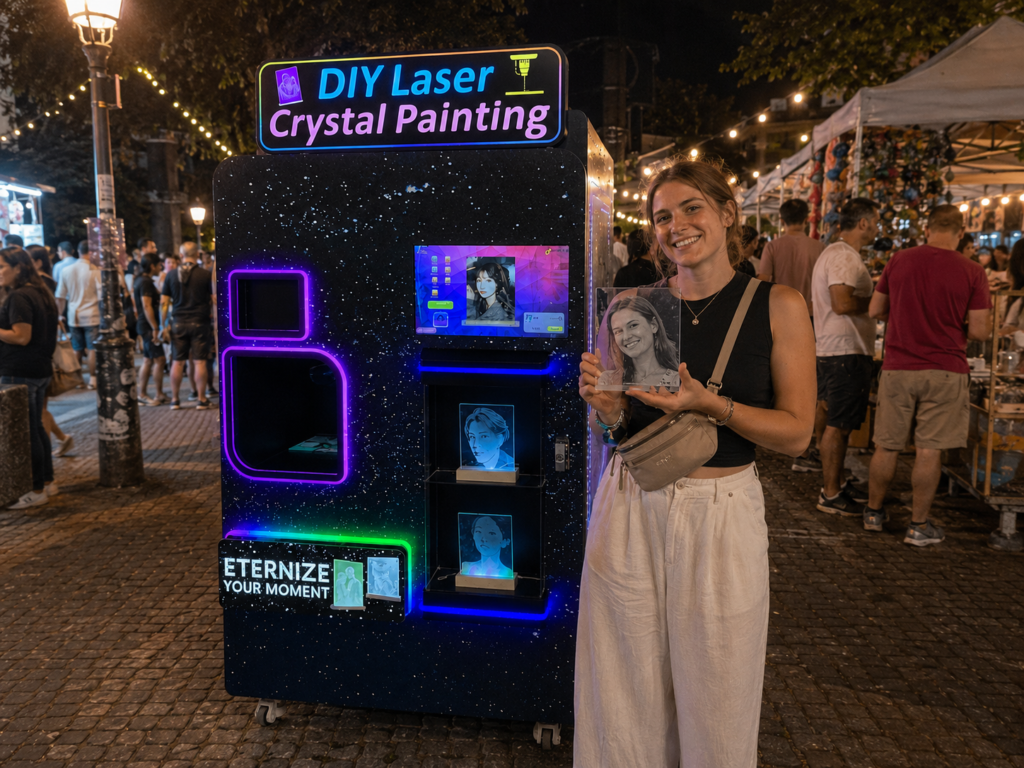
He moved the unit to a coastal aquarium two months later. Same machine, same city, completely different result. Families finish the exhibits, the kids are still buzzing, and someone says let’s get a souvenir with our photo on it. The machine started clearing eight to twelve orders a day. That move is the whole point of this guide. With a laser engraving vending machine, location is not a detail. It is the business.
Why placement decides everything for an engraving machine
Food vending sells on hunger and impulse. A snack or a cold drink needs no emotional setup. An engraved glass plaque needs the customer to be in a commemorative frame of mind. They have to want to mark a moment, a person, or a place. If the foot traffic around your machine is rushing, distracted, or task focused, the product simply does not land.
This is good news once you accept it. It means you are not competing for the busiest corner in town. You are competing for the right corner, the one where people already feel something. Get that right and a small, cheap footprint outperforms a prime mall site ten times its rent.
The five venue types, ranked
Here is how the locations I have tracked compare, based on reports from Red Rabbit operators running the CT-DK320. Numbers are ranges, not promises, and local factors move them a lot.
| Venue type | Typical daily orders | Price point | Lease difficulty | Revenue share |
|---|---|---|---|---|
| Tourist attraction | 8 to 15 | $35 to $50 | Mittel | 15 to 25% |
| Wedding or event venue | 6 to 12 on event days | $35 to $50 | Low to medium | 10 to 20% |
| High-end mall, jewelry district | 5 to 10 | $25 to $40 | Hoch | 10 to 15% |
| Family entertainment center | 4 to 8 | $25 to $35 | Mittel | 12 to 18% |
| Airport or transit with dwell time | 6 to 12 | $30 to $45 | Very high | 20 to 30% |
Tourist attractions are the anchor location
If I could place only one machine, it would go where visitors already spend money on memories. Aquariums, castles, observation decks, and theme park exits all share a pattern. People have their camera out, they have disposable income engaged, and a generic keychain means nothing compared with a glass panel carrying their own photo and the place name.
The aquarium operator I mentioned runs his machine near the exit gift shop. Peak season sits at ten to twelve orders a day at around $40 each. A Red Rabbit operator at a European castle site reported similar volume at 25 to 35 euros per piece, which works out to roughly 28,000 euros a year net after materials and the location fee. Mountain observation decks do well with honeymooners, who treat the engraved plaque as a wedding or anniversary marker.
Wedding and event venues are the margin play
Weddings concentrate exactly the right emotion and exactly the right budget in one room. The product writes itself: the couple’s photo, their names, the date, done in four to eight minutes while guests wait for the reception to start. Price it at $35 to $50 and nobody flinches, because everything at a wedding already costs too much.
A Red Rabbit operator in Dubai placed a unit at a banquet hall chain and averages six to eight orders per weekend event. The upsell is the easy win here. Parents, the wedding party, and grandparents all become extra sales once the first plaque is made. One machine, three hours of attention a month, and a few hundred to a thousand dollars per weekend.
Malls: placement beats traffic
Malls are the default first thought, and they can work, but raw footfall is a trap. A hallway between a shoe store and a phone repair shop produces lookers, not buyers. The fix is adjacency. Put the machine next to jewelry stores, photo studios, gift shops, or phone accessory kiosks, anywhere people are already in a gifting or personalization mindset. Operators consistently report three times the volume next to a jewelry counter compared with a sports outlet.
Before you commit, count foot traffic the right way. Stand at the exact spot on a Saturday between 2 and 5 p.m. and tally how many people pass. Then watch how many stop at anything nearby. A lively hallway with a thousand passers an hour but almost no one pausing is worse than a quieter spot where a quarter of walkers slow down.
How to negotiate the spot
Most venue managers have never considered a personalized gift machine, which is an opening rather than a problem. Lead with the experience, not the hardware. Show photos of finished etched glass. Explain that the machine draws a small crowd, which helps adjacent businesses too. Then propose terms that lower their risk:
- Revenue share over fixed rent. Offer 10 to 20 percent of sales. It costs them nothing upfront and aligns both sides with volume.
- A two week free trial. Let the location see real numbers from the IoT dashboard before anyone signs.
- A pitch deck of photos and sample products. Managers respond to proof. A tray of finished plaques does more than a spec sheet.
- Flexible exit. Because the unit is mobile, you can promise to relocate if the spot underperforms, which removes the venue’s fear of a dead corner.
Foot-traffic math you can actually use
You do not need a PhD in retail to sanity check a location. Use this rough funnel. Of the people who pass, a small share stop to watch the laser work. Of those, a smaller share buy. The watching step is what makes engraving different from a soda machine.
| Passers-by per hour | Stop to watch | Actually buy | Sales per hour |
|---|---|---|---|
| 300 (quiet hallway) | 1 to 2% | 0.3 to 0.5% | 1 to 1.5 |
| 800 (busy mall, right adjacency) | 2 to 3% | 0.5 to 0.8% | 4 to 6 |
| 1,500 (tourist exit, captive) | 3 to 5% | 1 to 1.5% | 15 to 22 |
A tourist exit with captive, dwell-heavy traffic converts five to ten times better than a generic hallway at the same raw volume. That is why the aquarium beat the mall for my friend, even though the mall looked busier on paper.
Red flags: locations that look great and fail
These spots show up in leasing brochures as premium and then quietly produce nothing for an engraving machine:
- Office lobbies. High traffic, zero emotional availability.
- Gym and fitness entrances. People are focused on the workout, not on gifts.
- Supermarket exits. Task focused, wallet closed, in a hurry.
- Transit without dwell time. Commuters move through, they do not linger. Only airports and stations with waiting areas and tourist flow work.
If you are unsure, the trial period solves it. Run the machine for two weeks and trust the dashboard over the brochure.
Seasonal planning keeps revenue steady
Tourist sites peak in summer and school holidays. Wedding venues run May through October in most markets. Malls spike in November and December. Spread your risk by placing machines across venue types, or by moving a mobile unit between a summer tourist spot and a winter mall. One Red Rabbit operator I know runs three machines and shifts one of them to a holiday mall from November to January, then back to a coastal attraction in spring.
Questions people ask about placement
Do I need the venue’s permission to install?
Yes. You are placing a powered machine in a public or managed space, so you need a written agreement covering power, space, and revenue share. Keep it simple and short.
What is a fair revenue share?
Most deals land between 10 and 20 percent of sales. Tourist sites and airports with high rent push toward the top of that range. Wedding venues, which want the amenity more than the income, often accept the lower end.
Can I relocate the machine later?
Yes, the machine is equipped with swivel casters so it can be pushed; manual lifting is not required.
Wie viel Platz braucht es?
The cabinet is about 82 by 118 by 206 centimeters and weighs 400 kilograms. Plan for roughly one square meter of floor space plus clearance for the door and service access. Standard wall power is enough.
Is the laser safe in a public space?
The beam is fully enclosed and the working area is contained, so customers never contact it. Any laser equipment deserves respect, and in the U.S. OSHA’s laser hazards guidance covers the basics of beam and non beam risks. The National Automatic Merchandising Association is also a useful reference for vending placement standards.
Not sure where your machine should go? Explore Red Rabbit’s laser engraving vending machine and talk to the team about site selection. Kontakt for a free location assessment based on your city and foot traffic.