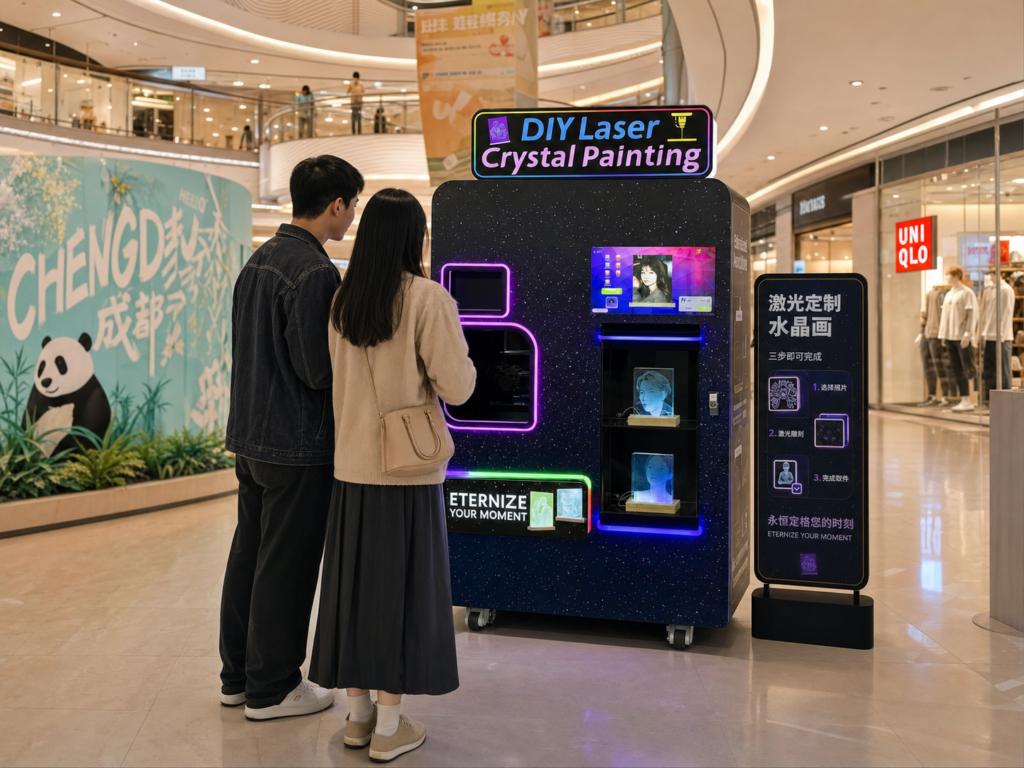
Six months ago I watched a woman in a Chengdu shopping mall design her wedding gift in real time. She uploaded a photo of herself and her fiancé to the machine’s touchscreen, typed “Forever Begins 2026” underneath, and waited. The laser traced their faces onto a glass panel in about four minutes. When the machine slid the finished piece into the collection tray, she cried. Not teared up. Actually cried.
The machine made $38 on that single transaction. Her extra plaque for the parents added another $32. Seven minutes, $70 in revenue, maybe $4 in materials. That’s when I stopped thinking about laser engraving vending machines as “interesting” and started thinking about them as serious business.
Red Rabbit sells a machine that does exactly this. It’s called the CT-DK320. It sits in a box the size of a vending machine, holds 80 glass blanks, and lasers 2D designs onto glass and acrylic panels while customers watch through a window. The machine is weirdly hypnotic to observe, which is relevant here because foot traffic that stops to watch also tends to buy.
What the Machine Actually Does
Let me be precise about the technology, because I got this wrong the first time and it matters for who wants to buy one.
This is not a 3D subsurface crystal engraver. It does not create floating images inside blocks of glass. It is a surface engraver. The laser etches 2D patterns, photos, and text directly onto the face of a glass or acrylic panel. The result is a frosted, permanent engraving—sharp, high-contrast, and durable. Think of it as a self-service trophy shop condensed into six square feet.
The machine can handle: – Photos converted to etched portraits – Text in dozens of fonts (names, dates, quotes) – Logos and simple vector graphics – Combination layouts (photo above, text below)
Customers interact through a touchscreen. They upload an image via QR code from their phone, or pick from pre-loaded templates. They position the image, adjust contrast, type text, and hit print. The machine does the rest.
Here’s what surprised me: the quality is actually good. I’ve seen laser-etched glass from services that charge $60–$100, and the output from this machine in a mall setting is comparable. The engraving is crisp, the contrast is solid, and the glass panels Red Rabbit supplies are proper thickness—not the flimsy stuff you’d get from a dollar-store frame.
The Numbers That Matter
The unit economics of a glass engraving machine are straightforward but worth laying out because they differ from food vending in one important way: there is zero spoilage. Glass panels don’t expire. If the machine has a slow Tuesday, nothing gets thrown away.
| Artikel | Low End | Typical | Premium |
|---|---|---|---|
| Blank glass/acrylic panel | $0.80 | $1.40 | $2.00 |
| Electricity per engraving | ~$0.05 | ~$0.05 | ~$0.05 |
| Total material cost | $0.85 | $1.45 | $2.05 |
| Selling price | $20 | $35 | $50 |
| Gross profit per sale | $19.15 | $33.55 | $47.95 |
Ten sales per day at the typical price point: $335 profit. Over a month, that’s about $10,000 in gross—and the machine cost ($4,900–$6,100) is covered in about three weeks. I’m rounding, but not by much.
The machine runs on roughly the same electricity as a desktop computer during the engraving cycle. Standby is lower. One operator I spoke with in Guangzhou tracks his electricity cost at ¥200/month (roughly $28). He laughed when I asked if it was a meaningful expense.
Where These Machines Work (And Where They Don’t)
Laser engraving machines are pickier about location than cotton candy or ice cream machines. The wrong spot won’t just underperform—it’ll sit there looking expensive and producing nothing. Here’s what I’ve found from talking to operators.
Tourist Destinations: The Obvious Winner
If I could only pick one location type for this machine, it would be a tourist attraction with high international traffic. The math is simple: tourists buy souvenirs. A generic keychain from a gift shop costs $8 and means nothing. A glass plaque with their family photo and “Paris 2026” laser-etched into it costs $40 and sits on their mantelpiece for a decade.
The emotional calculus changes when people are on vacation. They’re already spending. They’re already photographing everything. Your machine lets them turn one of those photos into a permanent object. A Red Rabbit operator at a European castle site told me his machine handles 8–12 orders per day during peak season at €25–35 per piece. Annual net from that single machine: about €28,000 after materials and location fees.
Wedding Venues: Small Footprint, Big Margins
This one is less obvious and potentially more profitable. Wedding venues are full of people in peak emotional states with money they’ve budgeted to spend. A laser engraving machine near the gift table or cocktail area captures that energy.
The product is obvious: the couple’s photo, their names, the wedding date. Done in four minutes. Priced at $35–50. Nobody flinches at the cost because it’s a wedding and everything costs too much. The machine occupies a square meter. A Red Rabbit operator in Dubai placed one at a wedding hall chain and averages 6–8 orders per weekend event. His math works out to roughly $800–$1,200 per weekend from one machine that costs him three hours of attention per month.
Malls: Traffic Wins, But Conversion Is Lower
Shopping malls are the default location most operators consider first. The foot traffic is there. The problem—and this is where I see operators make mistakes—is that mall traffic is diffuse and unfocused. Someone walking from H&M to the food court is not in “commemorate a life event” mode. They walk past. They don’t stop.
The fix is placement. Put the machine near jewelry stores, photo studios, gift shops, or phone accessory kiosks. Places where people are already in a gifting or personalization mindset. A machine next to a Pandora or Swarovski counter does three times the business of a machine next to a sports shoe outlet. I’ve checked.
Where It Won’t Work
Office lobbies. Gym entrances. Supermarket exits. These are high-traffic locations where nobody is emotionally available for a $35 personalized glass plaque. The machine will sit there, and you will wonder why the “great location” is producing 0.8 sales per day. The answer isn’t the machine. It’s the mismatch between the product and the mindset of the people walking past.
The Experience Is the Product
Here’s something I didn’t fully appreciate until I watched it happen: the engraving process itself sells the product. Customers don’t just receive a finished plaque. They watch it being made through a transparent window. The laser traces their photo in real time. It’s quiet, precise, and faintly mesmerizing.
This matters because it creates a small crowd. A crowd creates curiosity. Curiosity creates additional sales from people who had no intention of buying anything when they walked into the mall. One operator told me he sees roughly 15–20% of his daily sales come from people who stopped to watch someone else’s engraving and decided they wanted one too.
The machine is its own best advertisement. That’s rare in vending. Nobody watches a soda machine.
Setting Up: The First 30 Days
- Week 1: Order the machine. While waiting, scout locations—tourist areas, wedding venues, high-end malls with jewelry districts. Count foot traffic on a Saturday afternoon. Talk to adjacent business owners.
- Week 2: Secure a location. Wedding venues and tourist sites are often easier to negotiate with than malls. They understand the emotional product fit. Show them photos of the engraved glass. Explain the revenue-per-square-foot potential. Offer 10–15% revenue share.
- Week 3: Machine arrives. It ships pre-configured. Stock glass blanks and acrylic panels. Run test engravings with your own photos. Learn the interface. It takes about an hour to feel comfortable.
- Week 4: Go live. Post on local social media groups. Offer a launch discount ($5 off first engraving). Monitor sales daily through the IoT dashboard. Adjust glass blank inventory based on what’s selling.
- Month 2: Evaluate. If the location is producing 8+ sales per day, consider machine #2. If it’s under 5, consider relocating before blaming the machine. Nine times out of ten, poor performance is a location problem, not an equipment problem.
Why This Beats a Traditional Gift Shop
Traditional personalized gift businesses have three problems that a vending machine solves completely:
Staffing. Engraving shops need someone to run the laser, handle customers, process payments. The CT-DK320 does all of this autonomously. No wages. No scheduling. No training.
Rent. A retail unit with a storefront costs thousands per month. The machine occupies six square feet and plugs into a standard outlet. Mall operators who would never lease you a full storefront for a personalized gift business will happily rent you a corner for $400–600/month.
Hours. Gift shops close. The machine runs 24/7. That late-night couple wandering the mall after dinner who decides they want an engraved anniversary memento? They were never going to visit your shop during business hours. The machine captures sales that traditional retail leaves on the table.
I’m not saying laser engraving vending machines are the best business in the world. They’re not for every location, and they require more thoughtful placement than impulse food products. But in the right spot—a tourist destination, a wedding venue, a high-end mall with the right neighbor businesses—they print money with almost zero ongoing labor. That’s a rare combination.
Want to see the machine in action? Explore Red Rabbit’s laser engraving vending machine with factory-direct pricing and global shipping. Questions about whether your location is a fit? Contact the team for a free assessment.