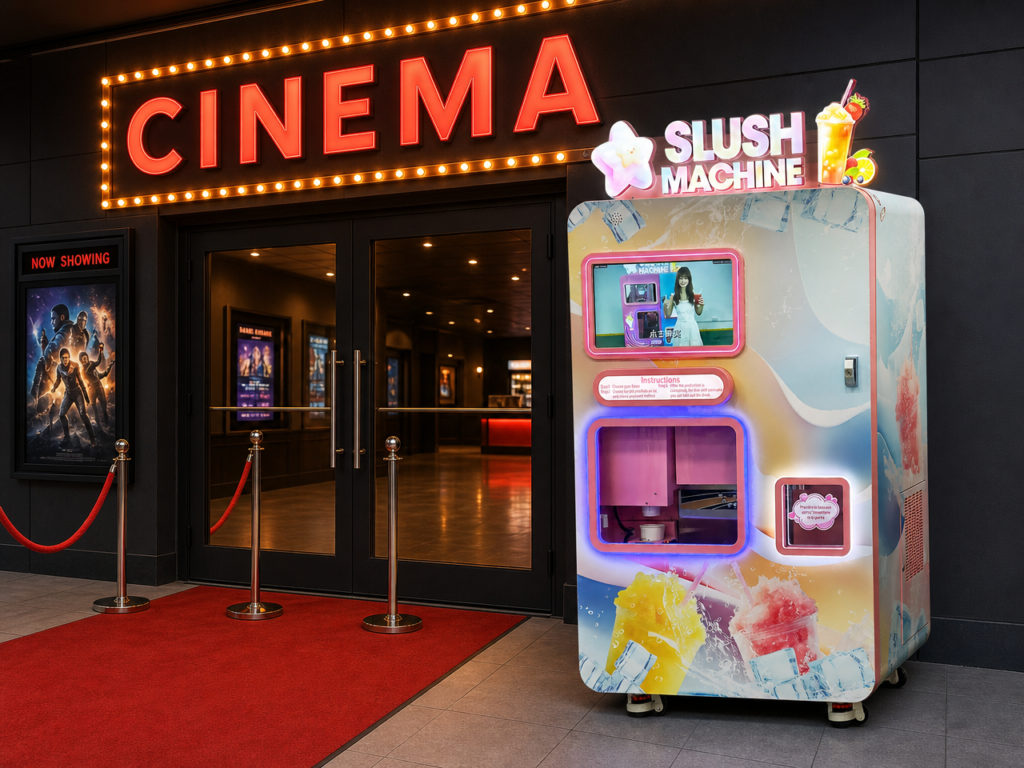
Everyone assumes the best place for an automated slush vending machine is somewhere hot. A water park. A beach. An outdoor festival. And they’re not wrong—those locations work. I’ve written about a guy in Thailand whose machine moves 60 cups an hour at a wave pool exit. But here’s what that story leaves out: his machine spends November through February doing roughly a third of that volume. The seasonal dip is real. The machine still makes money, but the cash flow is lumpy.
The operators who impress me more are the ones running slush machines indoors year-round. Cinemas. Malls. Bowling alleys. Their per-hour peak is lower—nobody does 60 cups an hour in a cinema lobby. But their machines run 365 days without a seasonal cliff, the locations are climate-controlled, and the maintenance headaches from outdoor exposure simply don’t exist.
This is the slush strategy that most new operators skip because it’s less obvious. It shouldn’t be.
The Red Rabbit CT-XN410: What You’re Actually Buying
Before getting into locations, let me describe the hardware, because understanding the machine explains a lot about where it belongs.
The CT-410 holds two flavor tanks, each with 12 liters of slush mix. That’s roughly 80 cups per tank before refilling. Three topping dispensers. The machine takes 40 to 90 seconds to produce a finished drink, depending on cup size and whether the customer wants toppings. It connects to Red Rabbit’s cloud dashboard for sales tracking, inventory alerts, and remote price changes.
Two things about this machine matter more than the spec sheet lets on.
First, the self-cleaning cycle. Slush is sticky. Sugar residue builds up in dispensing nozzles. The CT-410 runs an automated flush cycle that handles most of the internal plumbing. You still need to wipe external surfaces and change flavors every so often, but the 45-minute weekly routine is honest work, not a mystery.
Second, the machine is quiet. I’ve stood next to one in a cinema lobby and barely registered the compressor. That matters in indoor locations where ambient noise is low. A rattling compressor in a silent hotel lobby kills the vibe. The CT-410 hums.
Indoor Location Tier List
Cinemas: The Uncontested Best Indoor Location
Cinema slush sales follow a rhythm so predictable I could set a clock to it. Dead from opening to 2 PM. Waking up from 2 PM to 5 PM as after-school and early-evening crowds arrive. Peaking from 6 PM to 10 PM when the evening shows pack the lobby. Slowing down after 10 PM until close.
The key to cinema placement is proximity to the concession stand without being inside it. The cinema already sells fountain sodas. Your slush machine is not competing with their Coke—it’s a different product for a different craving. Place it near enough that families see it while waiting to buy popcorn, but far enough that it doesn’t feel like part of the cinema’s own menu.
One UK multiplex operator I talked to places his machines 15 to 20 feet from the main concession counter, angled toward the queue. “People standing in line for 10 minutes will stare at anything,” he told me. “If what they’re staring at is a glowing, spinning slush display, a percentage of them break off and buy.”
His numbers: 18 to 22 cups on weekdays, 35 to 40 on weekends. Average ticket: £3.50. Monthly net after the cinema’s revenue share and materials: about £2,800 per machine. He has three machines across three cinema locations.
Shopping Malls: Volume Over Margin
Malls offer something cinemas don’t: families browsing for hours. A cinema customer has maybe 15 minutes of lobby time. A mall family has an entire afternoon. The conversion rate is lower—most people walking past a slush machine in a mall corridor are not in drink-buying mode—but the sheer volume of foot traffic compensates.
The placement rule I’ve seen work consistently: put the machine near escalator landings or children’s play areas. Food courts are tempting but wrong—they already have drinks. Escalator landings create natural pause points where kids spot the colorful display and pull their parents toward it. Play areas are even better because the kids are already in entertainment mode and the parents are already spending money.
A Red Rabbit operator in a Southeast Asian mall reports 25 to 35 cups per weekday, 40 to 55 on weekends. Average price: $4. Monthly net after rent and materials: $3,800 to $5,200 depending on the season. The air conditioning helps—the mall is always comfortable, but walking around a mall still makes people thirsty.
Bowling Alleys and Family Entertainment Centers
This category surprised me. Bowling alleys don’t have cinema-level foot traffic, but the traffic they do have stays for two to three hours. That’s a lot of time for someone to get thirsty.
The product fit is specific: bowlers don’t want a meal, but a cold sweet drink between frames works. Parents with kids at the alley on a Saturday afternoon are already spending on games, shoes, and snacks. A $4 slush is the cheapest thing they’ll buy all afternoon, and it makes the kids happy.
One operator in a US family entertainment center reports 20 to 28 cups on weekends, 8 to 12 on weekdays. The venue charges a flat $300 monthly rent rather than revenue share, which works in his favor on high-volume days. Monthly net: roughly $2,200.
Hotels: The Sleeper Pick
Hotel lobby vending is underexplored for slush machines. Resort hotels, especially ones with pool areas, are obvious fits. But even business hotels with decent lobby traffic can work if the placement is right.
The trick is placing the machine near the elevator bank or the pool entrance, not in the lobby seating area. Hotel guests walking to and from the pool are primed for a cold drink. Guests waiting for the elevator with restless kids will buy a slush just to buy five minutes of peace.
A Red Rabbit operator at a resort hotel in the Caribbean reports 15 to 22 cups per day during peak season, 8 to 12 during shoulder months. Average price: $6. Monthly net after the hotel’s 15% revenue share: $2,800 to $4,200. The hotel loves it because it requires zero staff attention and adds to the guest experience.
Flavor Strategy for Indoor Locations
Indoor slush sales behave differently from outdoor sales. At a water park, people buy whatever is cold. At a cinema, they have preferences. The data matters.
Blue raspberry outsells everything. This is not a matter of taste. It’s a matter of visibility. Blue is the most unnatural-looking food color in existence, which makes it the most eye-catching. Kids see blue, they point at blue, parents buy blue. Across the indoor machines I’ve tracked, blue raspberry accounts for 55 to 65% of total volume.
Red flavors (strawberry, cherry) come second. About 25 to 30% of volume. Red is the second-most visible color and maps to familiar flavors that parents trust.
Exotic flavors underperform indoors. Mango, passionfruit, lychee—these sell at beach resorts where the tropical context makes sense. In a cinema in Manchester, they sit in the tank while blue raspberry sells out. Run one exotic flavor if you’re running dual-tank. Don’t run two.
On toppings: include them. The three topping options on the CT-410—typically sprinkles, popping boba, fruit pieces—add maybe $0.03 to $0.05 in cost and justify a $0.50 to $1.00 price bump. The visual appeal of colored sprinkles on a blue slush multiplies the impulse factor. Kids point harder. Parents cave faster. I’d include toppings even if they broke even on cost, which they don’t—they’re pure margin.
Maintenance Reality for Indoor Machines
The honest trade-off with slush machines versus dry vending: they need cleaning. The honest upside of indoor placement: they need less cleaning than outdoor.
Outdoor machines deal with dust, pollen, insects, and temperature swings that stress the compressor and accelerate sugar residue buildup. Indoor machines run in filtered air at stable temperatures. The self-cleaning cycle handles most of the work.
The weekly routine for an indoor CT-410 is about 30 to 40 minutes: drain residual mix from both tanks, run the automated flush, wipe external surfaces, refill. Every three to four months, do a deeper clean—disassemble the nozzle assembly, soak components, reassemble. The IoT dashboard reminds you when.
I’ve asked operators what goes wrong with these machines after six or twelve months of indoor operation. The most common answer: nothing. The second most common: a topping dispenser jams and takes two minutes to clear. For a machine that produces 500 to 800 drinks a month, that’s a maintenance-to-revenue ratio that makes sense.
Pairing Strategy: Slush + Something Else
Slush machines earn peak revenue during warm months and afternoons. They earn less during cold months and mornings. That’s a gap a second machine can fill.
The pairing that works: slush in indoor entertainment venues, cotton candy in the same venue type. The slush machine does its best work from 2 PM to 9 PM. Cotton candy does steady volume all day—kids want cotton candy regardless of the temperature. Combined, two machines in a cinema or family entertainment center generate $5,500 to $8,000 a month from a footprint under 15 square feet.
A different pairing: slush in summer-dominant locations, ice cream in winter-dominant locations. Different venues, same operator. The seasonal curves offset each other. When slush dips in December, ice cream holds steady in climate-controlled malls. When ice cream dips in January (post-holiday slump), slush starts its slow climb toward spring.
Ready to place a slush machine indoors? Browse Red Rabbit’s ماكينات بيع السلاش with dual flavor tanks, IoT connectivity, and self-cleaning systems. Want a profit projection for your specific location? Contact the team.