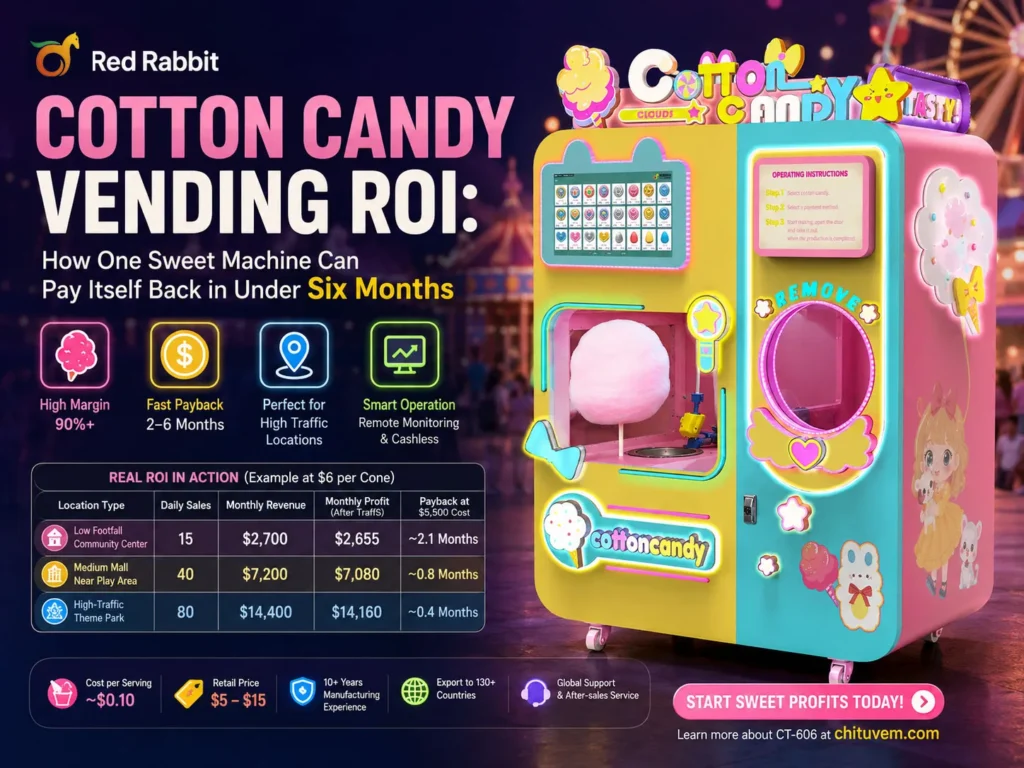
Why cotton candy vending stands out
I watched a Red Rabbit CT-606 run for a full Saturday at a family entertainment center in Kuala Lumpur. The operator told me he had stopped checking it every hour because the machine simply kept working. By closing time it had sold 71 cones at $6 each. His cost per cone, including sugar and stick, was around $0.10. That single day covered a meaningful slice of his monthly machine payment.
Cotton candy vending is attractive because the product is cheap to make and easy to price as a treat. Parents do not compare it to groceries. Kids ask for it by sight. In the right location, the machine becomes a small profit engine with very low labor.
Red Rabbit, also known as Chitu VEM, builds the CT-606 cotton candy vending machine at our factory in Guangzhou Panyu. We have more than ten years of manufacturing experience and export to over 130 countries. The CT-606 is built for continuous commercial use, with a sealed chamber, cashless payment options, and remote monitoring.
Unit economics of the CT-606
The numbers are straightforward. A standard serving costs roughly $0.10 in sugar and stick. Retail prices in most markets fall between $5 and $15, depending on venue. Even at the conservative end, the gross margin is enormous.
| Item | Value |
|---|---|
| Machine model | Red Rabbit CT-606 |
| Material cost per serving | ~$0.10 |
| Typical retail price | $5-$15 |
| Machine investment range | $3,700-$8,000 |
| Gross margin per serving | 90% or higher |
| Typical payback period | 2-6 months |
Three realistic location scenarios
Not every site performs the same. Below are three scenarios based on what Red Rabbit operators report. The numbers assume a $6 retail price and a $0.10 cost per cone.
| Location type | Daily sales | Monthly revenue | Monthly profit after COGS | Payback at $5,500 machine cost |
|---|---|---|---|---|
| Low footfall community center | 15 | $2,700 | $2,655 | ~2.1 months |
| Medium mall near play area | 40 | $7,200 | $7,080 | ~0.8 months |
| High-traffic theme park | 80 | $14,400 | $14,160 | ~0.4 months |
These figures ignore location rent or commission, which typically run 10% to 20% of revenue. Even after that, the net margin stays strong.
Where to place the machine
The best locations share one trait. People are already in a spending mood and they are not in a hurry. Shopping malls near children’s play areas, cinemas, arcades, amusement parks, zoos, and tourist attractions all work well. Grocery store entrances and commuter stations usually underperform because visitors are task-focused.
Space requirements are modest. The CT-606 needs roughly one square meter of floor space plus room for a short queue. Power and internet are the only utilities. A stable internet connection is important because cashless payments and telemetry depend on it.
What drives daily sales
Footfall is the obvious factor, but it is not the only one. Visibility matters. A machine tucked behind a pillar sells far less than one placed along the main walkway where children can see the spinning floss. Lighting, signage, and a short demo loop on the screen all increase impulse purchases.
Weather and seasonality play a role too. Cotton candy sells best in warm months and indoor leisure settings. An outdoor machine without shade or climate protection will struggle in summer heat or rain. Operators who plan for seasonality often move machines between locations or run promotions during slower months.
Payment options also affect conversion. A machine that accepts cards and mobile wallets will capture more sales than a cash-only unit. Parents rarely carry exact change, and children rarely carry cash at all.
Mistakes that eat your margin
The most expensive mistake is buying the machine before securing a location. I have seen operators store equipment for months while they negotiate mall contracts. Lock the site first, then order.
Another common error is using the wrong sugar. Standard granulated sugar will clog a vending machine. You need floss sugar with the correct grain size and flow agents. Red Rabbit supplies compatible sugar mix, and using it protects your warranty and your throughput.
Underpricing is also a problem. Operators sometimes charge $3 because they think lower prices drive volume. In most entertainment venues, $6 is an easy impulse buy and the lost revenue never comes back. Test pricing at different times and measure the result.
Finally, skipping telemetry is costly. Without sales data you are guessing when to restock, which products sell, and whether the location is profitable.
Running the machine day to day
Maintenance is simple but not optional. The sugar chamber needs a quick wipe every one or two hundred cycles. The stick hopper and dispensing nozzle should be checked weekly. A deep clean every month keeps the floss quality consistent and prevents sugar buildup.
Restocking is fast. One operator can service ten to fifteen machines in a day if the route is planned well. Remote monitoring tells you exactly when sugar is low, so you do not waste trips.
Training staff or location managers on basic troubleshooting also reduces downtime. Most jams clear with a simple reset, but only if someone on site knows the procedure.
How cotton candy fits a broader vending route
Most successful operators do not rely on one product. They pair high-margin experience machines with reliable staples. A cotton candy machine can share a location with an ice cream vending machine or a slush machine because the same audience wants treats. Red Rabbit’s full line also includes laser glass engraving, phone case printing, and jigsaw puzzle machines, so you can build a diversified route from one supplier.
Regulatory quick notes
Before you start, check local food vending rules. In the US, the FDA Food Code outlines safe handling for packaged and prepared foods. The SBA business guide covers permits, taxes, and basic bookkeeping.
Getting started
If you want a machine that produces a visible product, runs with minimal labor, and pays itself back in under six months, cotton candy is hard to beat. The key is location first, machine second. Walk the venue, count traffic, and choose a model with reliable support.
Start with one machine, prove the location, then duplicate what works. Scaling a vending route is much easier when the first unit is already profitable.
Ready to run the numbers for your location? View the Red Rabbit CT-606 cotton candy vending machine or contact us for a location-specific ROI estimate.