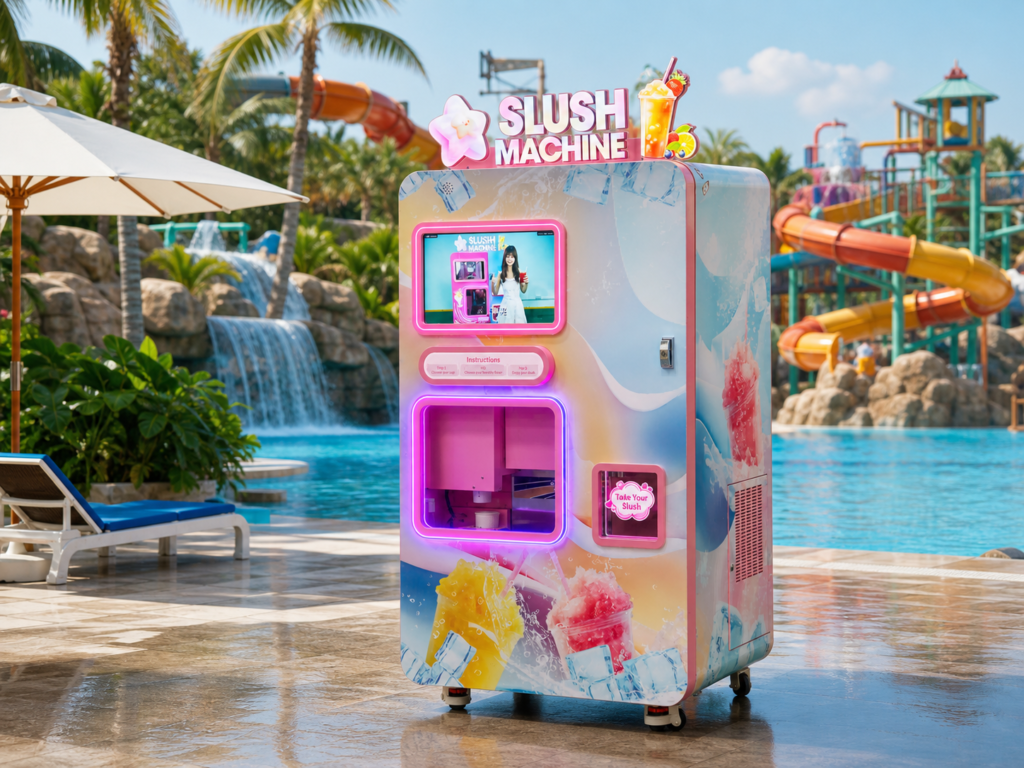
The most profitable vending machine I’ve personally seen in operation is not the one you’d guess. It’s not the cotton candy robot or the phone case printer. It’s a slush vending machine at a water park in Southeast Asia. The machine sits ten meters from the wave pool exit. On a hot Saturday in July, it moves 60 cups an hour. Sixty. At $5 a cup. With ingredient costs running about $0.60 per serving.
I asked the operator—a guy who owns twelve machines across four water parks and beach resorts—what he likes about slush machines versus his ice cream units. He didn’t hesitate. “Ice cream needs two flavors and toppings to feel right. Slush just needs to be cold and sweet. One flavor, one machine, no decisions. People walk past, they’re hot, they buy.”
He’s right about the psychology, but there’s more to why slush machines work so well as a business. Here’s the full picture.
The Brutally Simple Economics of Frozen Drink Vending
I’m going to lay out the numbers first because they’re the best part of this story. A slush vending machine—Red Rabbit’s CT-410 model—holds 12 liters of mix, dispenses 80 cups before needing a refill, and produces a finished drink in 40 to 90 seconds. The ingredient math is almost boring in its simplicity.
| Item | Cost |
|---|---|
| Slush mix per 12oz serving | $0.25–$0.35 |
| Cup + lid + straw | $0.08–$0.12 |
| Electricity per serving | ~$0.02 |
| Total cost per drink | $0.35–$0.49 |
| Typical selling price | $4–$7 |
| Gross profit per drink | $3.51–$6.65 |
At 20 drinks a day—a slow weekday at a mediocre location—you’re looking at about $80 in daily profit. $2,400 a month. At 40 drinks a day—a solid location on a summer weekend—about $200 daily, $6,000 a month. At 60 drinks an hour during peak water park hours, the machine clears $250–$350 in that hour alone.
The machine cost runs $4,380–$5,500. Even at the conservative 20-per-day number, you recover the investment in about 8–10 weeks of summer operation. At 40 per day, you’re looking at 4–5 weeks. I’ve seen operators in beach locations hit payback in under three weeks during peak season.
The Seasonal Reality (And Why It’s Fine)
Let’s address the obvious objection: slush is seasonal. Nobody orders a frozen drink in January in Chicago. This is true, and it matters, but less than most new operators assume.
First, seasonal doesn’t mean four months of work and eight months of nothing. A machine in an indoor mall, cinema, or year-round tourist destination operates 365 days. The seasonal problem applies to outdoor locations in cold climates, not to the entire product category.
Second, even for seasonal outdoor locations, the math still works. A machine that generates $6,000/month for five summer months and $800/month for seven off-season months produces $35,600 a year. After subtracting $5,000 for the machine and maybe $8,000 in materials and rent, that’s $22,600 in net profit from a $4,380–$5,500 investment. Show me another business with those first-year numbers and I’ll show you one with a lot more headaches than filling a slush tank once a week.
Third, slush machines pair beautifully with other seasonal machines to create year-round income. A water park slush machine that crushes it June through August can be complemented by a cotton candy machine in an indoor location that performs November through March. Different seasons, different machines, same operator, steady year-round cash flow.
Flavor Strategy: One vs. Two Flavors
Red Rabbit’s CT-410 holds two flavor tanks plus three topping options. Operators are split on whether to use both tanks or run the machine single-flavor.
The single-flavor camp argues simplicity. “Less to clean, less to stock, less to go wrong,” one operator told me. “I run blue raspberry all summer. Kids see blue, they want blue. Nobody asks for mango.” His machines average 25–30 cups a day at beach locations.
The dual-flavor camp argues conversion. “Some people don’t like blue raspberry,” another operator countered. “Offering strawberry alongside captures the 20% who would have walked past.” His machines average 30–35 cups a day in comparable locations.
My take: if you’re in a high-traffic location where volume is the priority, run two flavors. The additional complexity is marginal and the conversion uplift is real. If you’re in a moderate-traffic location or this is your first machine, start with one flavor. Master the operation, then add variety.
The three toppings—typically sprinkles, popping boba, and fruit pieces—are worth including regardless of your flavor count. They’re visual. Kids point at them. Parents buy them. The topping adds maybe $0.03 in cost and $0.50–$1.00 in price premium. That’s a margin decision that makes itself.
Where Slush Machines Belong
Water Parks and Beaches: The Natural Habitat
This is where slush machines achieve their peak form. Heat, crowds, and a product that’s literally designed for the environment. Water parks in particular are near-perfect slush vending territory: captive audience, predictable peak hours, and a customer base that’s already wet and doesn’t mind drips.
The operator I mentioned earlier—the one with twelve machines—placed his first unit at a mid-size water park in Thailand. First month, during the tail end of rainy season: 22 cups a day, $3,300 in revenue. Second month, as summer kicked in: 48 cups a day, $7,200. By his third summer season at that park, the single machine was generating over $10,000 a month during July and August.
Cinemas: The Indoor Goldmine
Cinema slush sales follow a predictable rhythm: dead from 10 AM to 2 PM, moderate from 2 PM to 6 PM, explosive from 6 PM to 10 PM. A machine placed near the concession stand captures the pre-movie drink rush without competing with the cinema’s own fountain sodas—different product, different customer.
One operator in a UK multiplex reported his machine averaging 18–22 cups on weekdays and 35–40 on weekends. Average transaction: £3.50. Monthly net after rent and materials: roughly £2,800. The cinema management loves it because it occupies zero additional staff and generates revenue share on top of their existing concession income.
Malls and Family Entertainment Centers
Indoor malls work well because the temperature is controlled and families browse for hours. The key placement insight: put the machine near escalators or children’s play areas, not in food courts. Food courts already have drink options. Escalator landings create dwell time—people pause, kids spot the colorful slush display, the sale happens.
Where Slush Machines Struggle
Office buildings. Transit stations during non-summer months. Outdoor locations without shade or shelter. The machine needs ambient heat or leisure context to trigger purchase intent. A slush machine in an air-conditioned office lobby in November is a very expensive decoration.
The Maintenance Reality
Slush machines require more cleaning than cotton candy or phone case machines. This is the honest trade-off that most manufacturer documentation glosses over. The mixing tank needs rinsing between flavor changes. The dispensing nozzle needs daily wiping. If you skip maintenance for a week, the machine still works but the product quality degrades noticeably.
The good news: Red Rabbit’s CT-410 has a self-cleaning cycle that handles most of the internal plumbing. The operator’s weekly routine is about 45 minutes: drain residual mix, run the cleaning cycle, wipe external surfaces, refill with fresh mix. That’s it. The machine alerts you through the IoT dashboard when it’s time for deeper maintenance—usually every 3–4 months for a full system flush.
Compared to a traditional concession stand selling slush drinks, which requires staff for every operating hour, the maintenance overhead of the vending version is trivial. A staffed slush stand costs roughly $1,500–$2,000 a month in wages for part-time coverage. The machine costs you 45 minutes a week and doesn’t call in sick.
Scaling: How One Operator Built a 12-Machine Slush Empire
The water park operator I mentioned started with one machine. Today he has twelve. His playbook is worth studying:
Phase 1 (Machine 1–3): Prove the model. He placed machines at three different water parks within a two-hour drive of each other. Different sizes, different demographics. He tracked per-machine metrics obsessively and identified which park type performed best.
Phase 2 (Machine 4–6): Cluster and optimize. He placed additional machines at the top-performing park type, clustering them near wave pools, lazy river exits, and kids’ splash zones. He negotiated volume discounts on slush mix by ordering in bulk for all locations.
Phase 3 (Machine 7–12): Expand to adjacent venues. Once the water park model was proven and documented, he approached beach resorts, hotel pools, and outdoor event venues with performance data from his existing machines. “I don’t pitch the machine anymore,” he told me. “I show them the per-square-foot revenue from my other locations and ask if they want a piece of that. Most say yes.”
His twelve machines collectively generate roughly $35,000–$45,000 a month during peak summer months. He spends about 20 hours a week on the business—driving between locations, restocking, chatting with venue managers. His brother handles maintenance and repairs. It’s not passive in the “check your phone once a month” sense, but it’s $400,000+ a year from a business that started with one $4,500 machine.
Ready to start your slush vending operation? Check out Red Rabbit’s slush vending machines with two flavor tanks, three topping options, and full IoT connectivity. Want to calculate your profit potential? Contact the team for a personalized projection based on your target location.