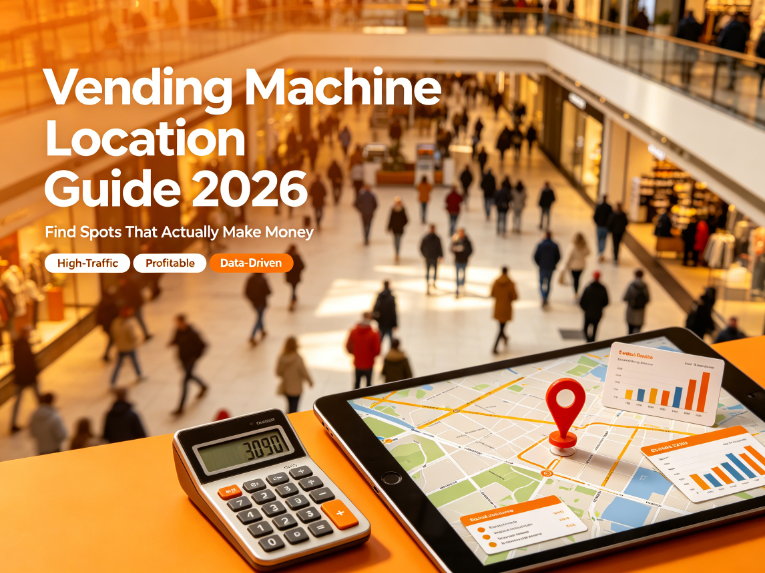
A vending operator I know has a rule. Before he buys any machine, he spends two weekends in folding chairs. He sits in the lobby of a potential location — mall, cinema, university — and counts people. Not estimate. Count. Clicker in one hand, notebook in the other. By Sunday evening, he knows exactly how many people pass through, at what times, and whether they linger or rush past. He’s placed 22 machines across four countries using this method. He’s never had a machine fail to turn a profit in its first month.
The lesson isn’t that you need a clicker and a folding chair. The lesson is that vending machine location isn’t a detail you figure out after buying the machine. Location is the business. A 6,000machineintherightspotwilloutperforma12,000 machine in the wrong spot every single time. This guide covers everything this operator learned — compressed into a framework you can use starting this weekend.
Why Most Vending Machines Fail (Hint: It’s Not the Machine)
The vending industry has a dirty secret: roughly 30% of new vending machines fail to generate meaningful profit in their first year. Walk through any city and you’ll find machines sitting in dead spots — office lobbies with 40 employees, strip malls with no anchor tenant, hotel corridors nobody uses. The machines work fine. The locations are the problem.
When a machine fails, the operator usually blames the equipment. “The payment system was glitchy.” “Customers didn’t like the product.” Rarely do they say, “I placed a machine in a lobby where 12 people walk by per day.” But that’s almost always what happened.
The numbers tell the story. A vending machine needs roughly 200–300 daily impressions — people who see the machine — to generate 10–15 sales. That means your location needs minimum daily foot traffic of 200–300 people passing within visual range of the machine. Less than that, and you’re running a very expensive decoration.
The Five Location Types That Consistently Print Money
Shopping Malls
Daily foot traffic: 5,000–50,000+ Average sales per day: 15–30 Rent range: 300–800/month or 10–15% revenue share Best machine types: Cotton candy, ice cream, phone case printing
Malls are the gold standard for automated vending. Climate-controlled, security-monitored, and packed with people in spending mode. The key is placement within the mall, not just being in the mall. Entrance zones, food court perimeters, and areas near children’s entertainment consistently outperform hallways and back corridors.
One crucial insight: mall placement near escalators or elevators captures upward and downward traffic. People naturally pause at these transition points, giving them an extra 3–5 seconds to notice and engage with your machine. That extra dwell time translates directly to higher conversion rates.
Negotiation strategy: Malls prefer revenue share agreements (10–15%) over flat rent because it aligns incentives. If your machine does well, they earn more. If it struggles, they don’t lose anything. Frame your pitch as a revenue partnership, not a rental request. Bring foot traffic data from other locations. Show them the math on per-square-foot revenue.
Amusement Parks and Tourist Attractions
Daily foot traffic: 3,000–30,000+ (seasonal) Average sales per day: 20–40 Rent range: 15–25% revenue share or 500–1,500/month Best machine types: Cotton candy, ice cream, slush, jigsaw puzzles
This is where pricing power peaks. The same cotton candy that sells for 8inamallsellsfor12–$15 at a theme park. Customers are in entertainment mode, their spending resistance is low, and the visual spectacle of a robotic cotton candy machine fits the environment perfectly.
The trade-off is seasonality. Outdoor amusement parks in northern climates operate 5–7 months per year. Indoor parks and year-round tourist destinations (Dubai, Singapore, Orlando) eliminate this problem. Factor seasonal revenue drops into your ROI calculations — a machine generating 4,000/monthforsixmonthsand1,000/month for six months still averages $2,500/month, which is perfectly viable.
Negotiation strategy: Tourist venues care about guest experience as much as revenue. Pitch your machine as an attraction that enhances the visitor experience — “interactive entertainment that also generates revenue per square foot.” Bring photos or video of machines in operation. The entertainment angle often opens doors that pure revenue pitches cannot.
Universities and College Campuses
Daily foot traffic: 2,000–15,000 (during semesters) Average sales per day: 12–25 Rent range: 200–500/month or 8–12% revenue share Best machine types: Ice cream, phone case printing, cotton candy
Campuses are underrated vending gold mines. Thousands of students with disposable income, confined to a few square miles, bored between classes, and highly active on social media — which means free word-of-mouth marketing.
The key to campus placement is proximity to high-dwell-time areas: student unions, library entrances, cafeteria perimeters, and dormitory common areas. Avoid academic buildings where students rush between classes without stopping. The student union food court at lunchtime is worth ten times more than a hallway in the engineering building.
Negotiation strategy: Approach the student union or facilities management department, not academic administration. Student unions often control vending contracts and are more responsive to revenue opportunities. Offer to sponsor a campus event or student organization as part of the deal — this builds goodwill and accelerates approval.
Transportation Hubs
Daily foot traffic: 10,000–100,000+ Average sales per day: 15–35 Rent range: 800–2,000+/month Best machine types: Phone case printing, ice cream, cotton candy
Airports, train stations, and bus terminals offer the holy grail of vending: massive 24/7 foot traffic from people with time to kill. The challenge is getting in. Airports especially have complex vendor approval processes, strict security requirements, and high rent that filters out casual operators.
If you can secure airport placement, the volume is extraordinary. A phone case machine in an international terminal can easily hit 25–35 sales per day at premium pricing. The rent is high but the revenue per square foot justifies it.
Negotiation strategy: Airports and major stations work through formal RFP (Request for Proposal) processes. You’ll need a business license, insurance documentation, and often a track record of operating in other locations. Start with smaller regional airports or bus terminals to build your portfolio before targeting major international hubs.
Cinemas and Entertainment Venues
Daily foot traffic: 500–3,000 (evening peaks) Average sales per day: 10–20 Rent range: 300–600/month or 10–15% revenue share Best machine types: Cotton candy, ice cream, slush
Cinema lobbies are compact, high-intent environments. People arrive early, mill around waiting for their movie, and are primed for impulse purchases. The two golden windows are the 20 minutes before showtimes and intermission periods during longer films. A cotton candy machine near the concession stand captures both the pre-movie excitement of kids and the post-movie treat-seeking of everyone else.
The Location Scouting Framework
Here’s the systematic approach used by operators who consistently place profitable machines:
Step 1: Identify Candidate Locations (Weekday Research)
Drive or walk through your target area. Look for:
- Clusters of retail or entertainment businesses — these aggregate foot traffic
- Waiting zones — anywhere people kill time (transit stops, ticket lines, food courts)
- Transition points — escalators, elevators, entrances, corridor intersections
- Children’s zones — toy stores, play areas, family restaurants
Mark 5–10 candidates on a map. Don’t filter yet. Just identify.
Step 2: Traffic Count (Weekend Observation)
Visit each candidate during three time windows:
- Weekday lunch (11:30 AM – 1:30 PM)
- Weekday evening (5:00 PM – 7:00 PM)
- Weekend afternoon (1:00 PM – 4:00 PM)
Count foot traffic for 15 minutes during each window. Multiply by 4 for hourly estimates. Compare across candidates. The top 3–5 become your shortlist.
Step 3: Competitor Audit
Check each shortlisted location for existing vending machines. Note what products they sell, their condition, and whether they appear actively used. A location with one vending machine doing well suggests room for more. A location with three neglected machines signals saturation or poor management.
Step 4: Pitch and Negotiate
Contact the location manager. Property management companies handle malls. Student unions handle campuses. Station management handles transit hubs. Prepare a one-page proposal that includes:
- Machine dimensions and power requirements
- Visual photo or video of the machine in operation
- Revenue projections based on observed foot traffic
- Proposed rent or revenue share structure
- Insurance and compliance documentation
Red Flags: Locations That Will Drain Your Bank Account
The “High Traffic, Wrong Traffic” Trap
A bus station has thousands of people. But they’re rushing to catch buses — they don’t stop. Always distinguish between through-traffic (people passing quickly) and dwell-traffic (people lingering). Through-traffic doesn’t buy. Dwell-traffic does.
Office Buildings Under 300 Employees
The math doesn’t work. Three hundred employees means roughly 150 people in the office on any given day (remote work, meetings, vacations). Of those, maybe 30–40 will walk past your machine. Of those, 3–5 might buy something. At 8persale,that′s32/day — not enough to justify the machine cost.
Outdoor Locations Without Shelter
Weather destroys vending machines. Rain shorts out electronics. Direct sun overheats cooling systems and fades displays. Wind blows debris into mechanical components. If a location doesn’t offer a roof or canopy, skip it — or budget for a weather-resistant enclosure that adds significantly to your setup cost.
“Friend’s Business” Locations
The restaurant your cousin manages. The gym where your friend works out. These feel like easy wins because you already have access. They usually aren’t. Personal relationships cloud business judgment. Rent discussions become awkward. Performance expectations get fuzzy. Place machines based on data, not favors.
Location Negotiation: The Revenue Share vs. Flat Rent Decision
| Factor | Revenue Share (10–15%) | Flat Rent |
|---|---|---|
| Best for | New locations, unproven spots | Established high-traffic locations |
| Risk | Shared — location earns when you earn | Operator bears all risk |
| Upside | Uncapped — high sales mean high rent | Capped — rent stays fixed |
| Relationship | Partnership-oriented | Transactional |
| Monthly cost (15 sales/day, $8 avg) | ~$360 | 300–800 |
Revenue share is almost always the better deal for new operators. It reduces your fixed costs during the critical early months when you’re learning the location’s true potential. If the location underperforms, your rent drops proportionally. If it exceeds expectations, the higher rent is fully covered by the additional revenue.
Scaling: From One Location to Ten
Once you’ve proven the model at one location, the scaling playbook is straightforward:
- Document everything. Traffic patterns, sales data, seasonal trends, maintenance schedules. Build a playbook that makes location #2 easier than location #1.
- Leverage your track record. When negotiating location #2, location #1’s performance data is your strongest negotiating tool. “Our machine at Westfield Mall generates $4,200/month in a 6-square-foot footprint. We’d like to bring the same performance here.”
- Cluster geographically. Place machines within a 30-minute drive of each other. This minimizes restocking travel time and makes multi-location management practical for a solo operator.
- Diversify location types. One mall, one campus, one tourist spot, one transit hub. If one sector underperforms (e.g., pandemic hits transit), the others compensate.
Found your perfect location? Browse Red Rabbit’s full range of automated vending machines — from cotton candy to phone case printers. All machines include IoT management dashboards, multi-language support, and lifetime technical assistance. Not sure which machine fits your location? Contact our team for a free consultation.