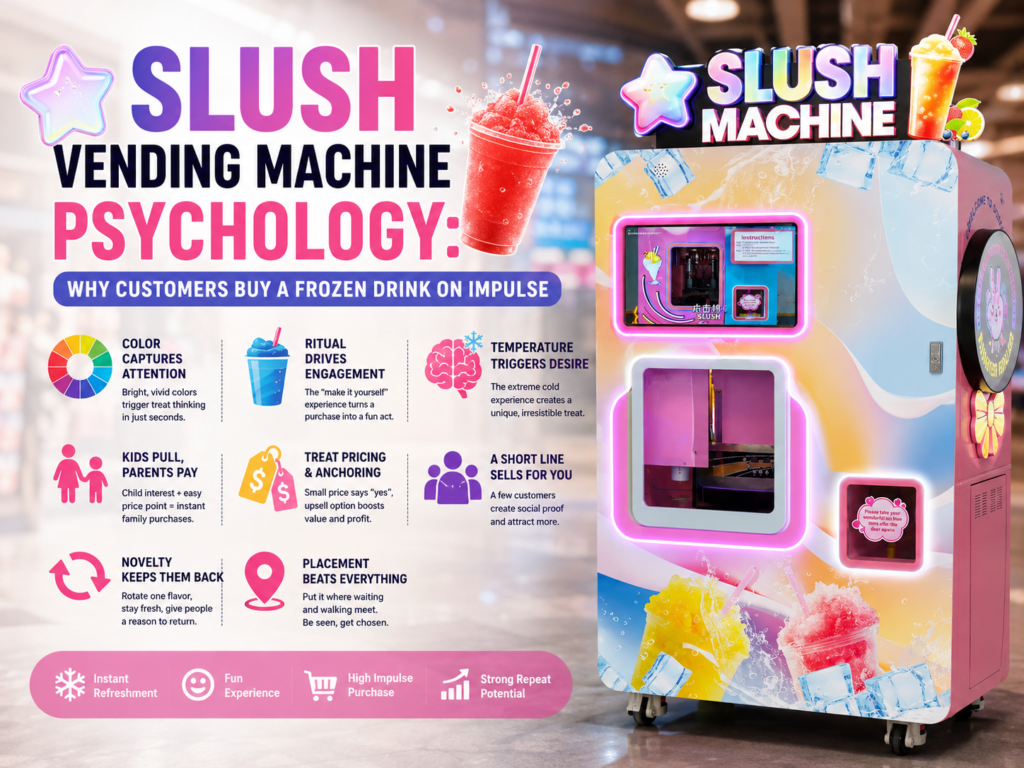
A woman walks past a convenience store on a hot afternoon. She did not plan to buy anything. Then she sees the frozen drink machine behind the glass, a few bright colors turning in slow circles. Ten seconds later she is holding a cup. That is the whole slush business in one sentence. Nobody writes a frozen drink on a shopping list, and that is exactly why the category works.
Slush vending machines sell a decision made at the machine, in seconds, for reasons that have almost nothing to do with thirst. Understand those reasons and you can place, stock, and price a machine to catch more of those split-second choices. Ignore them and you own an expensive freezer sitting in a corner. This article walks through the psychology that moves the cup from the dispenser into a customer’s hand, and how to use it in a real location.
Color is the first salesperson
A customer sees color before she reads a price. A slush machine with three or four vivid flavors reads as a treat the moment you glance at it. Operators who understand this keep the machine full, the flavors separated, and the brightest option at eye level. A half-empty machine with muddy, mixed colors signals neglect, and customers pick up that signal in about two seconds.
There is a reason candy aisles and frozen drink counters both lead with bright blue and neon red. Those colors read as fun, not as hydration. If you want someone to buy flavored ice for the experience rather than the thirst, you stage the color first. That means choosing flavors partly by how they look in the tank, not only by how they taste.
The machine turns a drink into a ritual
Buying a bottle from a fridge is a transaction. You grab it, pay, leave. A 雪泥自动售货机 turns the same purchase into a small ritual. The customer picks a cup, chooses a flavor or two, and pulls a lever to watch the frozen drink swirl in. That five-second act feels like making something, and people value what they feel they made.
I watched an operator test this directly. He moved from a timed dispenser to a setup where the customer held the cup and pulled the handle themselves. Sales at the same machine, in the same location, at the same prices went up. The only thing that changed was the feeling of participation. People reach for a lever more readily than they wait for a spout to stop.
Temperature is a trigger, not a feature
Most products compete on being cold. Slush competes on temperature being an event. The brain freeze, the crunch of ice crystals, the way a flavor hits differently when it is almost frozen. None of this is on the ingredient label, and all of it is part of why people buy.
For an operator this changes what you think you are selling. You are not selling a drink. You are selling thirty seconds of cold novelty on a warm day. That frame tells you where to place the machine, how to price it, and how to describe it on a sign.
Kids pull, parents pay
A large share of slush sales follow one script. A child stops, points, and the parent decides the small cost is worth a quiet minute. The purchase is not rational for the parent, it is social. The machine needs to sit at child eye level, with flavors bright enough to draw the point and a price low enough that the parent says yes without doing math.
Operators who sell to families usually keep a small cup at a price that feels like pocket change. The parent says yes to the small cup, the child is happy, and the machine builds a habit. On the next visit the child points again without being prompted. That repeat loop is the real asset you are building.
Price anchoring and the treat frame
A slush rarely competes with a bottle of water on price, and it should not try. It competes with other small treats. A cup of flavored ice priced like a candy bar sits in the same mental category as a candy bar, a thing you buy for a lift rather than for survival. When you frame the slush as a treat and price it that way, the customer compares it to snacks and impulse items, not to beverages.
The lever to pull is a clear small size and a clear upgrade. The small cup is the yes. The larger cup with an extra flavor is the upsell that costs a few cents of syrup and earns a better margin. Customers anchor on the small price and feel smart about the upgrade, even though the upgrade is where the profit lives.
A short line is free advertising
Nobody wants to be the first person at an empty machine. A small queue, even two people, tells the next person this is worth buying. This is why a busy few minutes at lunch can turn into a longer run. The first few customers pull in the ones behind them.
You can encourage this gently. Run a visible launch promo on day one so a line forms, and keep service moving so the line never becomes a reason to walk away. A machine that looks used is a machine that looks proven.
Novelty wears off, so rotate on purpose
The first time a customer tries a slush is the strongest. The tenth time needs a small reason to come back. Rotating one flavor on a schedule, a seasonal color, or a limited flavor named after something local, keeps the machine from becoming background. You do not need a new menu every week, just enough change that the machine still gets a second glance.
The key is to rotate deliberately and not all at once. Keep the two best sellers fixed, and change the third slot. Customers who come for the favorite still find it, and the curious ones have a reason to look again.
Placement beats almost everything
Psychology only works if the customer sees the machine. A slush machine buried behind a counter is invisible. A slush machine on the path to the exit, lit and spinning, catches people who already decided to leave. The classic mistake is treating placement as a leftover decision. It is the biggest lever you control after the machine itself.
High traffic, a short wait nearby, and warmth all help. A queue is a gift, because a bored person standing still for a minute is exactly the person who looks at a colorful machine and reaches for a cup. Put the machine where waiting happens and it sells itself.
Turning the psychology into a setup
None of this requires a bigger machine or a more expensive location. It requires a few deliberate choices. Keep three or four vivid flavors, separated and full. Put the machine where waiting and walking cross. Price a small cup like a treat and a large cup like an obvious upgrade. Let the customer pull the lever. Watch what happens, then change one variable at a time.
Food safety sits underneath all of it. A machine that dispenses a food product needs the same care as any food business, from cleaning mixing and dispensing surfaces to keeping syrup at the right temperature. The National Automatic Merchandising Association publishes vending best practices, and the FDA Food Code covers the food handling standards you are expected to meet. A clean, well-stocked machine is also better psychology, because the color and clarity of the product stay intact.
The operators who do well with slush rarely talk about the machine first. They talk about the customer’s thirty-second decision and how to win it. If you want help matching a machine to a location, the team at 赤兔智能 can walk you through the XN-410 line and what has worked in real locations.
A slush machine does not sell a drink. It sells thirty seconds of cold novelty, and every choice you make should make that moment easier to say yes to.