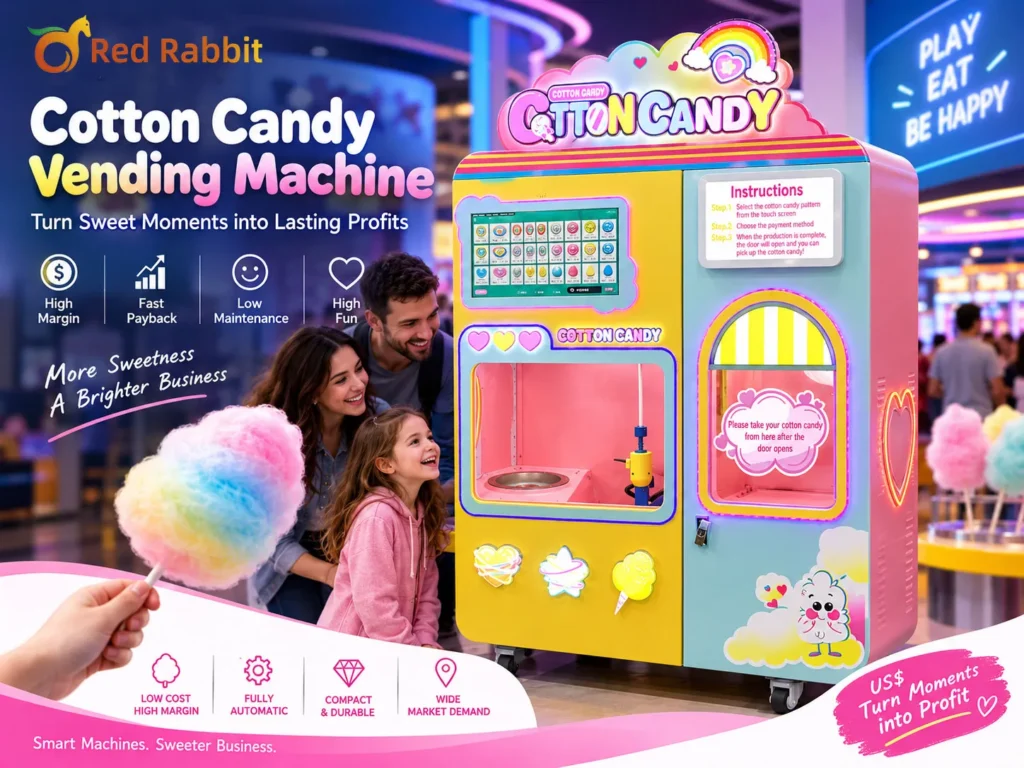
A friend of mine put a cotton candy vending machine in a family entertainment center last year. Before the machine arrived, he ran the numbers on a spreadsheet and figured he would sell thirty cups a day. His first month, he sold twelve. By month three, after tweaking the placement and adjusting the price, he was at forty-five cups a day and netting around four thousand dollars a month from a single machine. The difference was not the machine. It was understanding what actually drives sales.
Cotton candy vending works because the economics are absurdly simple. The raw material cost per serving runs about ten cents. The machine sells each cup for five to fifteen dollars depending on the location. That is a margin that makes almost every other vending category look thin by comparison. The question is not whether the unit economics work. The question is whether you put the machine where enough people actually buy.
The real numbers behind the CT-606
Red Rabbit’s cotton candy vending machine, the CT-606, is the model most operators I have spoken to use. It is a fully automatic unit that turns granulated sugar into a spun cotton candy serving in about two minutes. The machine holds enough sugar and sticks for around 100 to 150 servings before needing a refill. Power draw is modest, running on standard single-phase power, and the footprint is compact enough to fit in a mall kiosk, a cinema lobby, or a theme park snack zone.
Here are the unit economics as operators report them:
| Метрика | Conservative | Typical | Strong location |
|---|---|---|---|
| Daily cups sold | 8 to 12 | 15 to 25 | 30 to 50 |
| Per-cup material cost | $0.10 | $0.10 | $0.10 |
| Average selling price | $5 | $8 | $12 |
| Daily revenue | $40 to $60 | $120 to $200 | $360 to $600 |
| Monthly revenue | $1,200 to $1,800 | $3,600 to $6,000 | $10,800 to $18,000 |
| Monthly consumable cost | $24 to $36 | $45 to $75 | $90 to $150 |
| Location rent or share | $300 to $500 | $500 to $800 | $1,000 to $2,500 |
| Estimated monthly net | $800 to $1,300 | $2,800 to $5,000 | $8,000 to $15,000 |
The machine itself costs between $3,700 and $8,000 depending on configuration, shipping, and customization. At the typical range of net earnings, payback runs two to six months. That is faster than almost any other automated retail category, and it is the main reason cotton candy vending keeps attracting new operators.
What location type actually works
The big mistake new operators make is assuming that any high-traffic spot will print money. Cotton candy sells on impulse and emotion, not utility. The buyer is not hungry. They want the experience of watching the machine spin sugar into a colorful puff, and they want to walk around holding it.
Family entertainment centers and arcades are the anchor location type. Kids are already in spend mode, parents are looking for small indulgences, and the machine itself becomes part of the entertainment. One operator in a mid-sized arcade in the US Midwest reported 40 to 55 cups a day at $8 each during summer weekends. Winter weekdays dropped to 10 to 15 cups, but the seasonal average still cleared $4,500 a month net.
Shopping malls, especially near the food court or the cinema entrance, are the second strongest. A machine placed where families pause between shopping and eating can do 20 to 30 cups a day. The key is visibility. If the machine is tucked in a corridor, it underperforms. If it is in the open where kids can see the cotton candy forming, it converts.
Theme parks, zoos, and aquariums are the third tier, and potentially the most profitable on a per-cup basis. Prices at these venues routinely hit $10 to $15, and volume is high during peak season. The trade-off is that the lease share tends to be higher, often 20 to 30 percent, and the season can be short. Operators who place machines in seasonal venues often pair them with a year-round indoor location so the unit earns all twelve months.
What kills a cotton candy machine
There are a few common reasons a CT-606 underperforms, and none of them are the machine’s fault.
First, placing it where people are in a hurry. Transit stations, office lobbies, and supermarket exits are full of people who are late for something. They will not stop to wait two minutes for a spun sugar treat. The machine needs a dwell zone where people are already killing time.
Second, setting the price too low. New operators sometimes price at three or four dollars to drive volume, but that signals low quality and kills margin. Cotton candy at five to eight dollars feels like a small treat. At three dollars it feels like a machine nobody wants. Pricing at the right level is half the conversion battle.
Third, ignoring the demo factor. The machine is its own best advertisement. A looping screen demo showing the sugar spinning into a finished product lifts conversion by roughly 20 percent, according to operators who track this. If the screen just shows a static logo, walk-by traffic walks by.
Supply and maintenance are minimal
One of the underrated advantages of a cotton candy machine is how little ongoing supply it needs. The consumables are granulated sugar, food-grade paper sticks, and optional flavor and color additives. A single restock handles 100 to 150 servings. Compare that to a snack machine that needs dozens of SKUs restocked weekly, and the operational simplicity is obvious.
Maintenance is similarly light. The spinning head needs a cleaning every few hundred cycles, which takes about ten minutes. The sugar hopper is a wipe-down. There are no refrigeration components to fail, no expiry dates to track, and no complex mechanical parts that need a technician. For an operator managing multiple machines across different locations, the cotton candy unit is the lowest-maintenance asset in the fleet.
You can see the full Red Rabbit CT-606 cotton candy vending machine specifications and current pricing on the product page. For operators considering their first purchase, the SBA small business guide covers the basics of business registration, financing, and tax compliance in the US market. The National Automatic Merchandising Association also publishes placement guidance and industry benchmarks that are worth reviewing before you sign a location agreement.
How operators scale from one machine to a route
The most successful cotton candy vending operators I have tracked follow a simple pattern. They buy one machine, place it in a proven location type, and run it for three to six months until they have real sales data. Then they use that track record to negotiate better terms at a second location, buy a second machine, and repeat.
At three to five machines, the operator typically hits a point where the monthly net income replaces a full-time job. The beauty of this category is that the machines run unattended. Your job is restocking, cleaning, and checking the app to confirm everything is running. One operator in Southeast Asia runs seven cotton candy machines across malls and arcades with about twelve hours of work per week. His monthly net clears twenty thousand dollars.
Cotton candy vending is not a get-rich-quick scheme. But for someone willing to scout good locations, test prices, and keep the machines clean and stocked, it is one of the most reliable profit engines in automated retail right now. The numbers are real, the demand is consistent, and the operational burden is lower than almost any other vending category you can enter.
Ready to see if a cotton candy machine fits your market? Explore the CT-606 vending machine details, then связаться с Красным Кроликом to discuss shipping, power requirements, and customization for your region.