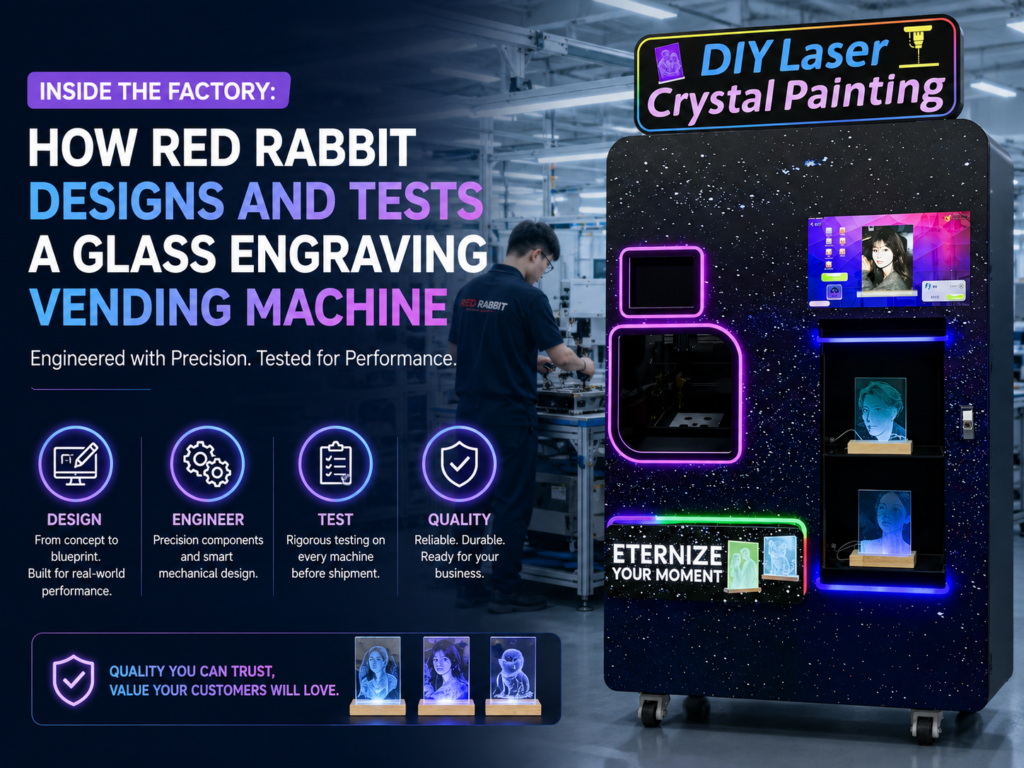
The first time I walked onto the production floor in Panyu, Guangzhou, the thing that surprised me was not the size of the space or the number of machines in assembly. It was how long a single laser engraving unit sat on the test bench before anyone would let it leave the building. A technician told me the machines earn their spot in a shipping crate the slow way, one calibration and one stress test at a time.
Most buyers never see this part of the process. They see a vending machine that takes a photo, engraves it onto a piece of glass or acrylic, and collects twenty to fifty dollars for the finished piece. What they do not see is the reasoning behind every part inside, and that reasoning is exactly what decides whether a machine runs quietly for years or eats an operator’s weekends with service calls.
Why we engrave the surface instead of inside the glass
This is the question I asked first, because a lot of people assume a laser glass machine carves a three dimensional image inside a solid block. That is a different product with different physics, and it is not what Red Rabbit builds. The CT-DK320 engraves the surface of glass or acrylic in a two dimensional design. The choice is deliberate.
Surface engraving is faster, it works on flat and curved pieces, and it does not need a tightly sealed optical path. A machine that marks the surface also has fewer points of failure, because the laser head does the work directly instead of firing through a lens array into the middle of a block. For an operator, that means less calibration drift and fewer returned jobs. I have heard operators describe the internal crystal machines as beautiful but fussy. Surface engraving is the version that keeps earning while the operator sleeps.
The laser comes first, then everything else follows
Every design decision on this machine starts with the laser module. The team sources the tube or diode, then measures how long it holds a steady power output before the beam wanders. Beam consistency matters more than peak power, because a vending machine customer will not accept a photo that came out sharp on Monday and faint on Thursday.
Once the laser is settled, the engineers build outward. The linear rails that move the head, the rotary attachment for cylindrical glasses, the camera that frames each photo. Each of these gets its own tolerance spec, and each gets checked against a reference engraving before it is signed off. The reference piece sits in a cabinet by the line, covered in test patterns, so a new technician can compare a fresh run against what a good run looks like.
Cooling, dust, and the parts nobody thinks about
Lasers run hot, and heat is the enemy of repeatability. A machine that overheats drifts out of focus, and an out of focus laser produces soft, washed out engravings. So the cooling loop gets as much attention as the laser itself. The engineers run the machine at full duty cycle in a closed room and watch the temperature curve, not just the engraving quality.
Dust is the quieter killer. Engraving glass throws off fine particles, and those particles settle on lenses and mirrors. Red Rabbit seals the optical path and adds a fume extraction port, then tests the seals with a smoke stick before the covers go on. This is the kind of detail that never appears in a sales brochure, but it is the difference between a machine that needs its lens cleaned every month and one that runs for a season untouched. Safety is part of the same conversation, and laser exposure is regulated for good reason. Operators who want the full picture can read the hazard guidance published by OSHA on laser hazards.
The 500-hour burn-in and what fails when we test
Before a machine ships, it runs a burn-in cycle that most buyers would find boring to watch. Hundreds of hours, real engravings, cycling through glass and acrylic and back again. The point is not to prove the machine works on day one. The point is to find what breaks on day forty.
The engineers keep a failure log, and the log is honest. A connector loosens. A cooling fan bearing gets noisy. A software edge case appears when a customer uploads a photo with odd dimensions. Each entry gets a fix, and the fix gets folded into the next production run. This is why the machine an operator receives today is a little different from the one that shipped six months ago. The product does not stand still.
Glass versus acrylic, and why we test both
A single machine handles two materials because buyers want both. Glass looks premium and carries a higher price. Acrylic is lighter, cheaper to stock, and less likely to shatter in a busy location. The laser parameters for the two are not the same, so the software stores separate profiles and switches automatically when the operator selects the material. Testing both means a machine does not arrive at a mall kiosk with a profile that only half works.
Stocking logic matters too. An operator buying a glass engraving vending machine is really buying a small production line that runs on blanks, and the blanks are the recurring cost that decides the margin. Keeping both glass and acrylic on the shelf lets the operator match the material to the occasion and the price point without changing hardware.
What this means for the person who signs the invoice
None of this factory work is glamorous, and most of it is invisible to the customer who drops a coin in the slot. But it all lands in one place, which is downtime. Every hour a machine sits dark because of a drifted laser or a clogged lens is an hour of revenue that is gone for good. The factory testing is a bet that a machine built carefully at the source will cost less to run over five years than a machine assembled to the lowest possible price.
That is the trade a buyer is really making. Red Rabbit has spent more than ten years exporting vending equipment to over 130 countries, and the machines that come back with the fewest complaints are the ones that got the boring, patient treatment on the line. If you want to talk through what a surface engraving machine looks like in your specific location, the team answers through the contact page with real numbers, not a script.