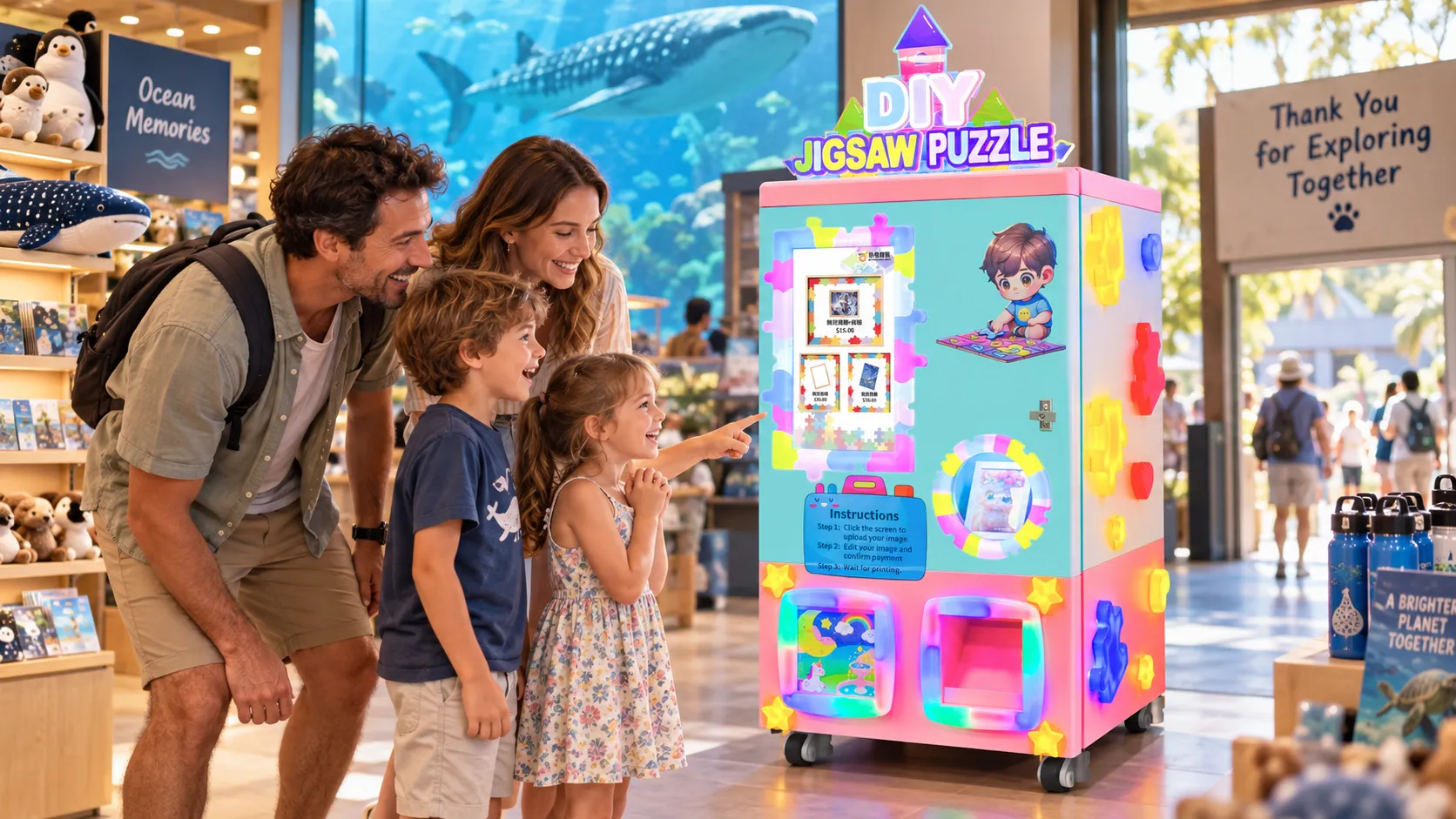
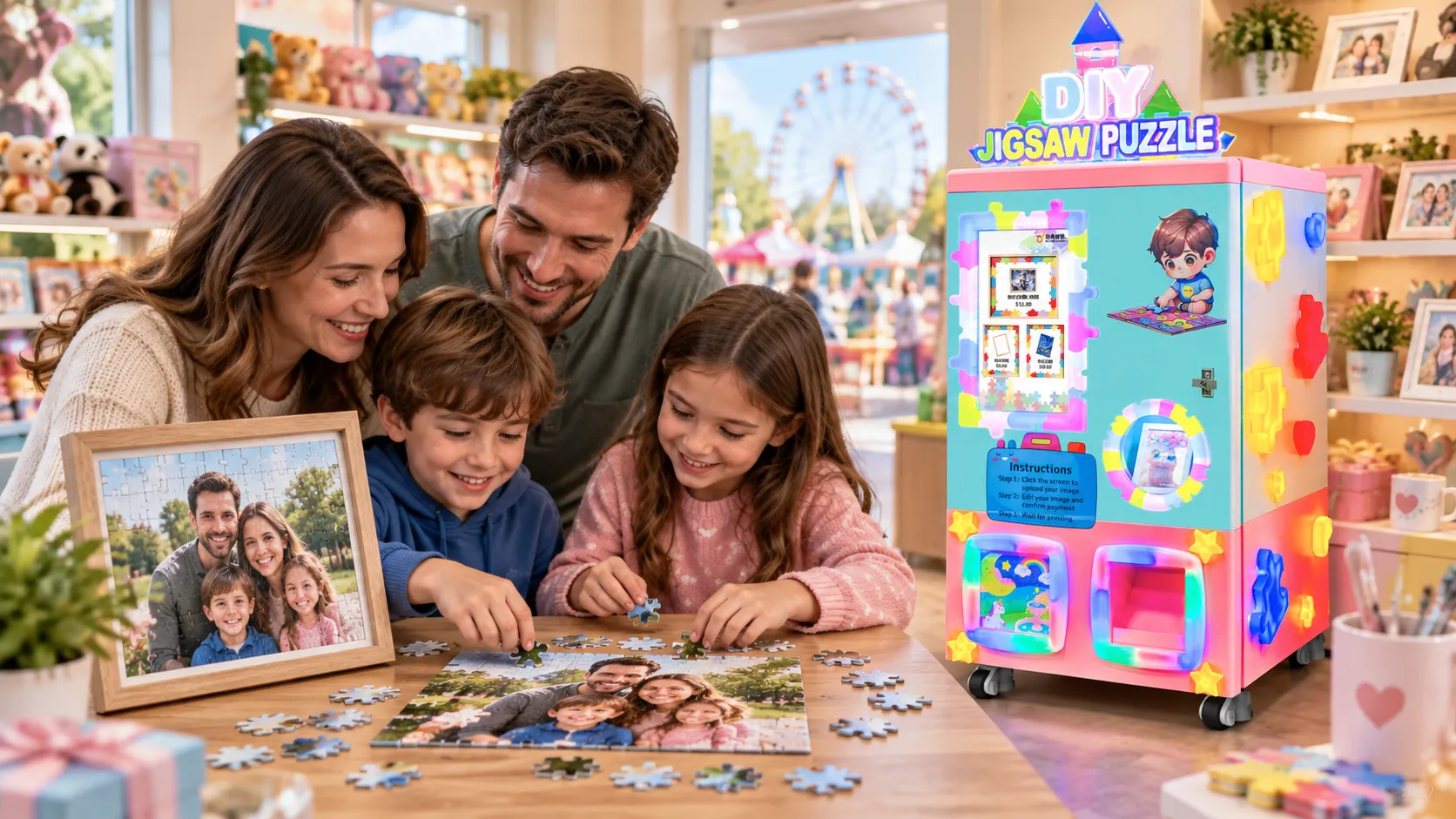
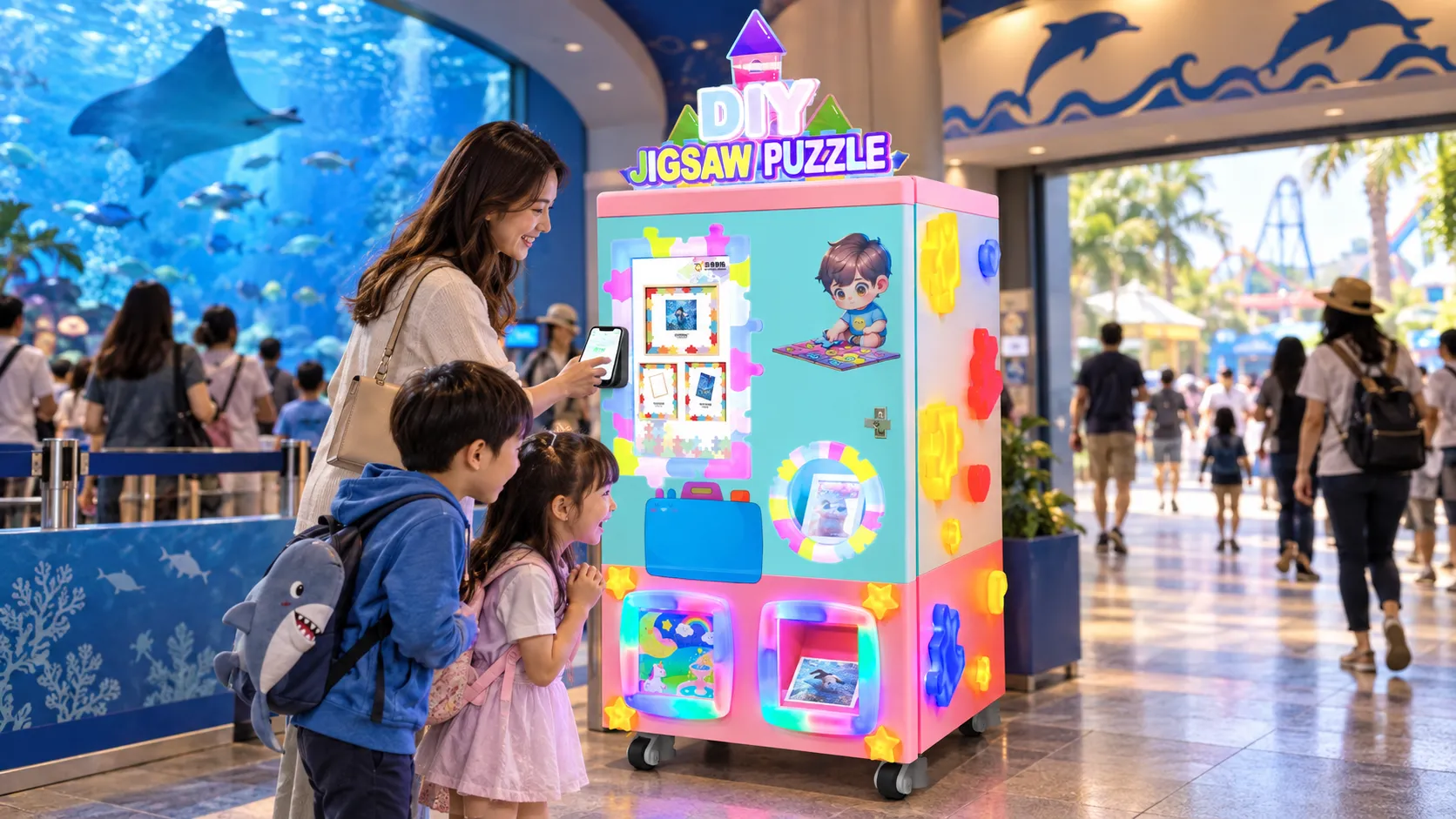
I watched a family stop in front of a puzzle vending machine in a zoo gift shop last spring. The mother held up her phone, picked a photo of the three of them by the penguin tank, and tapped the screen. The machine started printing. Both kids pressed their noses to the glass to watch. Four minutes later a finished jigsaw puzzle slid into the tray, and the mother laughed before she even picked it up. Nobody in that family had planned to buy anything when they walked through the door.
That is the whole trick behind a jigsaw puzzle vending machine. It does not compete on price. It competes on a feeling that already exists in the room. If you understand where that feeling comes from, you understand where to put the machine, how to present it, and why it keeps selling long after the novelty of a normal vending machine fades.
Why a photo puzzle feels different from a souvenir
A generic keychain with the zoo logo on it is a reminder that you visited a zoo. A jigsaw puzzle with your own faces in front of the penguin tank is a reminder of that specific afternoon. One is a product. The other is a memory you can hold. That difference changes the buying decision entirely, because people do not haggle with themselves over the value of a memory the way they do over the value of a trinket.
Personalization does something else too. It moves the object from one of thousands to the only one. A printed magnet that looks identical to the one in the next gift shop is easy to put down. A puzzle that contains a photo that exists nowhere else cannot be replaced by anything on the shelf behind you. Scarcity here is not about limited stock. It is about the image being yours alone.
The IKEA effect: people value what they help finish
There is a well documented quirk of behavior that researchers call the IKEA effect. People place a higher value on things they had a hand in building, even when the assembly is trivial. A jigsaw puzzle taps into that directly. The machine prints the pieces, but the customer is the one who sits at the kitchen table and turns a flat image into a whole picture.
That small act of completion matters. It means the keepsake is not a thing you were handed, it is a thing you finished. The value of the puzzle grows in the buyer’s mind before a single piece is assembled, because part of the purchase is the anticipation of that quiet task at home. A fridge magnet gets stuck to the fridge and forgotten. A puzzle gets carried to the car, brought inside, and placed on a table, which means it keeps occupying mental space long after the sale.
The gift impulse: buying a moment, not a product
Many puzzle sales are not for the person standing at the machine. They are gifts. A grandparent watching the kids pick a photo is already picturing it on a shelf at their house. A parent buys one for the other parent who stayed home. A friend grabs one after a birthday trip. Spending on someone else feels more justified than spending on yourself, which is why the gift framing quietly loosens the wallet.
This is why the framed format exists as an option. It turns the keepsake from a box on a shelf into a display piece ready to be given. The standard format leans toward a personal activity, the framed format leans toward a present. The machine does not have to explain any of this. The two buttons sit side by side, and the customer picks based on intent without a word of persuasion.
Kids are the real buyer
Watch who actually makes the purchase decision at one of these machines and you will notice a pattern. The adult pays, but the child drives. The machine is built at a height a child can reach, the printing is visible, and the reward is something they get to keep and assemble. When a child points and asks, most parents have a hard time refusing a small, wholesome request in the middle of a good day out.
That is pester power, and it is one of the oldest forces in retail. It works especially well here because the ask is not junk food or a toy with a short lifespan. It is a photo of the family. Refusing it feels a little like refusing the memory itself, which is exactly the kind of small emotional pressure that turns a passing glance into a completed sale.
The machine lowers the barrier to a yes
There is no staff to ask, no queue at a counter, and no one watching you decide. A self serve machine removes almost all the social friction that stops a purchase. The customer stands there alone with a screen, makes the choice in private, and taps to pay in a few seconds. The shorter the path from wanting it to done, the more likely the yes.
Card and phone payments matter more than operators sometimes realize. Cash makes every purchase feel heavier because you can watch the money leave. A tap on a phone feels almost weightless, which is why the same customer who would hesitate over coins will happily approve a card payment for a keepsake. The less the transaction feels like spending, the more it feels like grabbing a moment before it disappears.
Price anchoring and the small ask framing
Most customers do not judge a photo puzzle against the cost of cardboard. They judge it against the cost of the day around it. The tickets to the zoo, the food, the parking, the little treats along the way. Against that backdrop, a personal keepsake is a small add on, not a big decision. The machine does not compete with the price of a puzzle sold in a toy store. It competes with the value of the memory it preserves.
Operators who try to win on being the cheapest option are fighting the wrong battle. The buyer here is not comparison shopping. They are in the middle of an emotional moment, and the machine simply offers them a way to keep it. That is a very different frame, and it is why a photo keepsake can command a price that a plain puzzle on a shelf never could.
Location is where the emotion already lives
The machine cannot create the feeling that drives the sale. It can only catch it. So placement is not a logistics question, it is an emotional one. Zoos, aquariums, theme parks, wedding venues, birthday party centers, school event halls. These are places where people are already having a day worth remembering. The machine sits at the exit or the midpoint and converts that feeling into a product before it cools off.
A photo puzzle machine in a plain hallway near a bus stop will underperform no matter how good the hardware is, because there is no emotion there to catch. The same machine at a theme park exit, right where families pass with tired legs and full phones, becomes one of the easiest sales in the building. Emotion decays quickly once people walk away from the experience. Catch it while it is warm.
Two formats, one decision
إن jigsaw puzzle vending machine from Red Rabbit keeps the offer simple on purpose. A single puzzle product in two formats. The standard format is the keepsake you build at home. The framed format is the gift you hand to someone. There is no long menu of confusing options, which keeps the decision fast and the psychology clean.
That simplicity is part of the design thinking. A machine that offers twenty formats makes the customer stop and deliberate, and deliberation is the enemy of an impulse buy. Two clear choices keep the customer moving from photo to purchase in under a minute, which is exactly the window where the emotional case for buying is strongest.
What this means for an operator
If you run one of these machines, or you are thinking about it, the lesson is to stop treating it like a product dispenser and start treating it like a memory catcher. Put a finished sample on top where people can see the result before they start. Keep the screen to two or three clear steps. Let people watch the print happen, because the show is part of the pitch. And choose a location where the emotion already exists rather than hoping the machine can manufacture it.
Impulse buying is not random. It follows a pattern. A personal image, a small act of completion, a gift on the line, a child asking, and a location that already feels good. A ماكينة طباعة أغلفة الهاتف آلة البيع works on the same emotional logic, which is why the two machines often thrive side by side. When you see that pattern clearly, the machine stops being a gamble and starts being a tool you place with confidence. If you want to know whether your venue has that emotion in it, talk to the Red Rabbit team before you commit.
إن National Automatic Merchandising Association has long tracked how impulse and self service converge in vending, and the pattern holds across every category. The difference with a photo puzzle is that the impulse is attached to a personal memory rather than a craving or a convenience. That is a stronger bond, and it is the reason the sale sticks.
People do not buy a photo puzzle because they need one. They buy it because the moment is right and the machine made saying yes feel effortless.